

 English
 Español
 Русский
 العربية
 Français
 Deutsch
 Português
 Tiếng Việt
 ไทย
 Bahasa Indonesia
 Türkçe
 Italiano





In heavy industry, “standard” often implies robust but bulky. However, the European Standard Gantry Crane represents a distinct engineering philosophy rooted in DIN and FEM standards. Unlike traditional CMAA (Crane Manufacturers Association of America) Class D or E cranes that rely on massive structural weight for durability, European designs prioritize high-strength steel utilization, compact geometry, and modularity.
For facility planners and procurement engineers, understanding these differences is critical. Choosing a European Standard Gantry Crane is not just about lifting capacity; it is a strategic decision to reduce building construction costs, maximize usable headroom, and lower long-term energy consumption.
Core Technical Distinctions: Why “European Standard” Matters
The term “European Standard” in crane engineering refers to specific design criteria that differentiate these machines from conventional heavy industrial cranes.
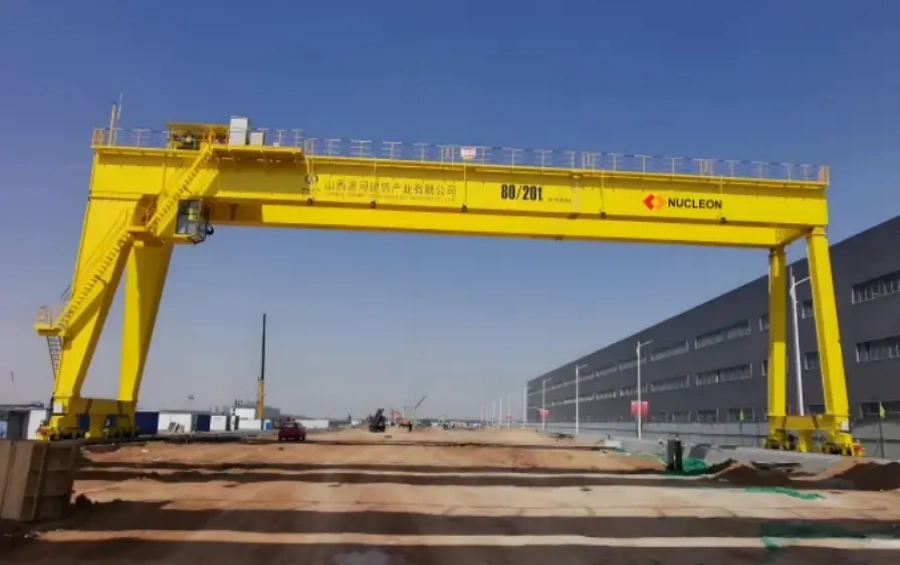
Lightweight Structure & High-Strength Steel
European gantry cranes typically utilize Q355B or higher grade high-strength low-alloy steel. This allows for thinner web plates and smaller flange widths while maintaining structural integrity.
•Result: The self-weight of a European Standard Gantry Crane can be 20% to 30% lighter than a traditional equivalent.
•Impact: This significantly reduces the load on runway beams, columns, and foundations, allowing for lighter (and cheaper) supporting steel structures in new buildings.
Compact Dimensions & Low Headroom
A defining feature is the integration of wire rope hoists with compact drum designs (often featuring helical grooving). The hoist trolley is designed to minimize the distance between the hook centerline and the end truck wheels.
•Headroom Optimization: These cranes require less vertical space between the hook and the main beam bottom flange.
•Facility Benefit: In existing facilities with height restrictions, this allows for higher lifting heights without raising the roof. In new builds, it reduces the overall building height requirement.
Modular Maintenance Design
European designs emphasize modularity. Key components like the hoist unit, trolley drive, and long travel drives are often independent modules.
• Serviceability: If a hoist motor fails, it can often be replaced as a single unit without dismantling the entire trolley frame.
• Downtime Reduction: This “plug-and-play” approach drastically cuts maintenance time compared to welded, integrated assemblies found in older designs.
Application Scenarios Where European Standards Excel
While traditional heavy cranes dominate extreme-duty sectors (like continuous steel mill tapping), the European Standard Gantry Crane is the superior choice for:
1. General Manufacturing & Assembly: Where precision positioning and variable speed control (via VFDs) are more critical than raw impact resistance.
2. Warehousing & Logistics: High-cycle operations where energy efficiency and speed matter. The lighter mass means less inertia, requiring smaller motors and less electricity to start/stop.
3. Retrofit Projects: Installing cranes in older buildings where the existing runway beams cannot support the massive wheel loads of traditional cranes. The lighter wheel load of European cranes makes them ideal for upgrades.
4. Clean Rooms & Sensitive Environments: The enclosed gearbox designs and reduced need for open gearing minimize lubricant contamination risks.
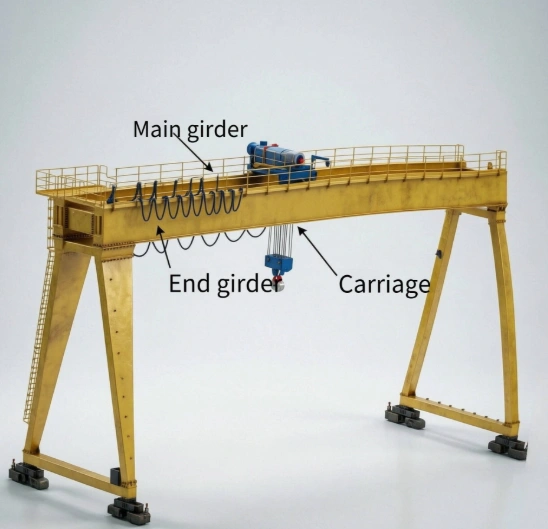
Selection Guide for Procurement Engineers
When specifying a European Standard Gantry Crane, focus on these parameters rather than just “tonnage”:
| Parameter | Consideration for European Standard |
| Duty Class (FEM/ISO) | Typically FEM 1Am, 2m, or 3m. Ensure this matches your actual load spectrum. Over-specifying to “M8” when “M6” suffices adds unnecessary cost. |
| Span & Cantilever | European gantries often utilize optimized box-girder or truss designs. Check the deflection limits (usually L/800 or L/1000) to ensure compatibility with your process precision. |
| Power Supply | Verify voltage/frequency compatibility (e.g., 400V/50Hz/3Ph). European hoists often use rotary limit switches and encoded overload protection as standard, not optional extras. |
| Control System | Look for integrated VFDs on all motions. European standards favor smooth acceleration curves to reduce load swing, essential for assembly tasks. |
Installation & Commissioning Considerations
Due to their modular nature, European Standard Gantry Cranes offer installation advantages but require specific attention:
•Rail Alignment Tolerance: Because these cranes are lighter and often run on smaller wheels, they can be more sensitive to rail misalignment than heavy cranes. Strict adherence to ISO 12488 tolerance standards for runway rails is mandatory to prevent premature wheel flange wear.
•Bolted Connections: Many European gantries use high-strength bolted connections for field assembly rather than site welding. Ensure your installation team uses calibrated torque wrenches and follows the manufacturer’s tensioning sequence precisely.
•Electrical Termination: Modular designs often use multi-pin connectors for quick assembly. Verify that all safety circuits (E-Stops, limit switches) are hard-wired or use certified safety-relay protocols, not just standard PLC inputs.
Frequently Asked Questions
Q: Is a European Standard Gantry Crane less durable than a traditional heavy-duty crane?
A: Not necessarily. It is designed for a different duty cycle. While a traditional CMAA Class E crane is built for constant full-load impacts (like molten metal), a European Standard crane (FEM 2m/3m) is engineered for high-cycle, precise lifting with optimized fatigue life. For 90% of general industrial applications, the European design offers a better balance of lifespan and efficiency.
Q: Can I replace my old crane with a European Standard model?
A: Yes, this is a primary use case. Because European cranes are lighter, they often fit onto existing runway beams that were originally sized for heavier equipment. However, you must verify the wheel load distribution and runway straightness, as the lighter weight changes the dynamic interaction with the rail.
Q: Are spare parts harder to source for European Standard cranes?
A: Generally, no. European Standard cranes utilize components from major global suppliers (e.g., SEW/Eurodrive motors, Schneider/Siemens electrics, SKF bearings). These are off-the-shelf industrial items, unlike proprietary parts sometimes found in niche heavy-lift brands.
Q: What is the typical lead time for a European Standard Gantry Crane?
A: Due to their modular design and standardized components, manufacturing cycles are often shorter than custom-built heavy cranes. Standard configurations can frequently be delivered in 4-8 weeks, depending on span and lift height, whereas heavily customized units may take longer.