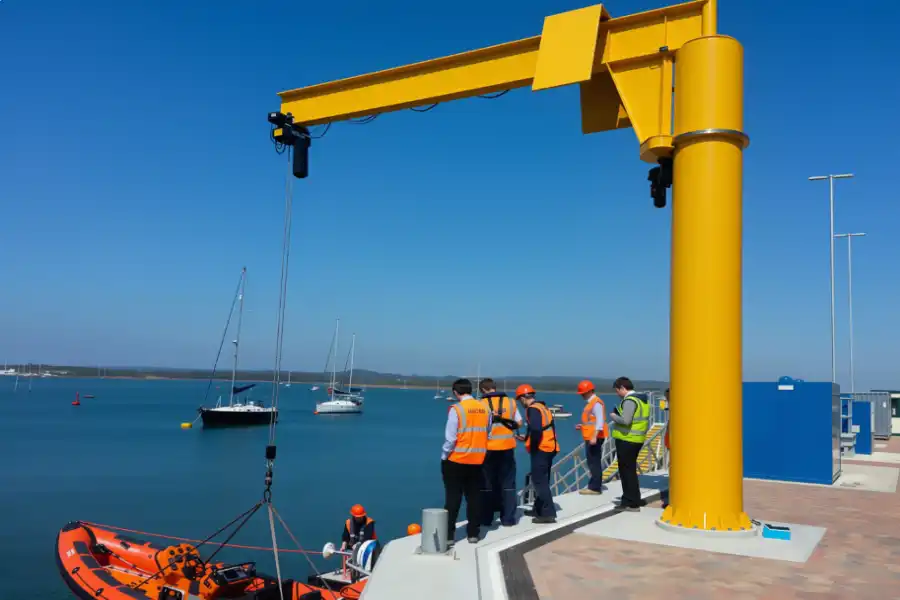







1. What is a Floor Mounted Slewing Jib Crane?
Simply put, a floor mounted slewing jib crane is a localized lifting system that operates around a fixed pivot point. Visually, it looks like a giant, heavy-duty mechanical arm.
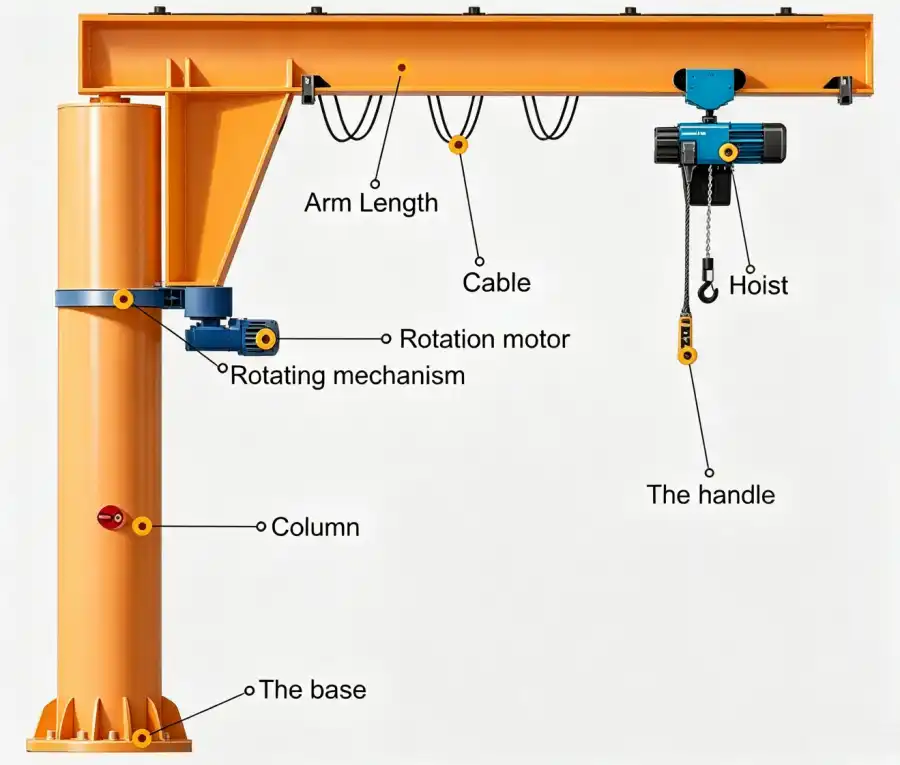
It consists of three main components:
●The Mast (Pillar): A sturdy vertical steel column anchored securely to the factory floor.
●The Jib Arm (Boom): A horizontal beam that extends from the mast.
●The Hoist & Trolley: An electric or manual hoist that travels back and forth along the horizontal arm.
The term "slewing" refers to its primary movement: the horizontal arm can rotate (slew) around the vertical mast, typically offering a full 360-degree range of motion. Combined with the hoist moving along the arm and lifting vertically, this crane can easily cover a complete circular working area.
2. When Should You Use It?
Unlike overhead cranes that move heavy loads across an entire building, a floor mounted jib crane is designed for highly repetitive, localized tasks. It is the perfect fit when:
●Machine Tending: Loading and unloading heavy parts into CNC machines, stamping presses, or assembly stations.
●Workstation Lifting: Moving components along a specific assembly line or packaging station.
●Maintenance Bays: Lifting heavy engines or equipment in a dedicated repair area.
●Loading Docks: Transferring goods from a truck to a specific staging area.
If your lifting needs are concentrated within a 3 to 10-meter radius, a jib crane is likely your best option.
3. What Are the Key Advantages?
Adopting a floor mounted slewing jib crane brings immediate benefits to your facility:
●Ergonomics & Safety: It drastically reduces the physical strain on workers by eliminating manual lifting, thereby minimizing workplace injuries.
●Precision Control: Because the crane operates in a fixed zone, operators can position loads with pinpoint accuracy, reducing the risk of product damage.
●Inceased Productivity: Workers spend less time rigging loads and waiting for large overhead cranes, leading to faster cycle times at individual workstations.
●Spce Optimization: It requires zero overhead runway beams, leaving the upper airspace and floor space completely free for other operations.
4. Jib Crane vs. Overhead Bridge Crane: Which is Better?
For beginners, the biggest question is often: “Why not just use a traditional overhead crane?”
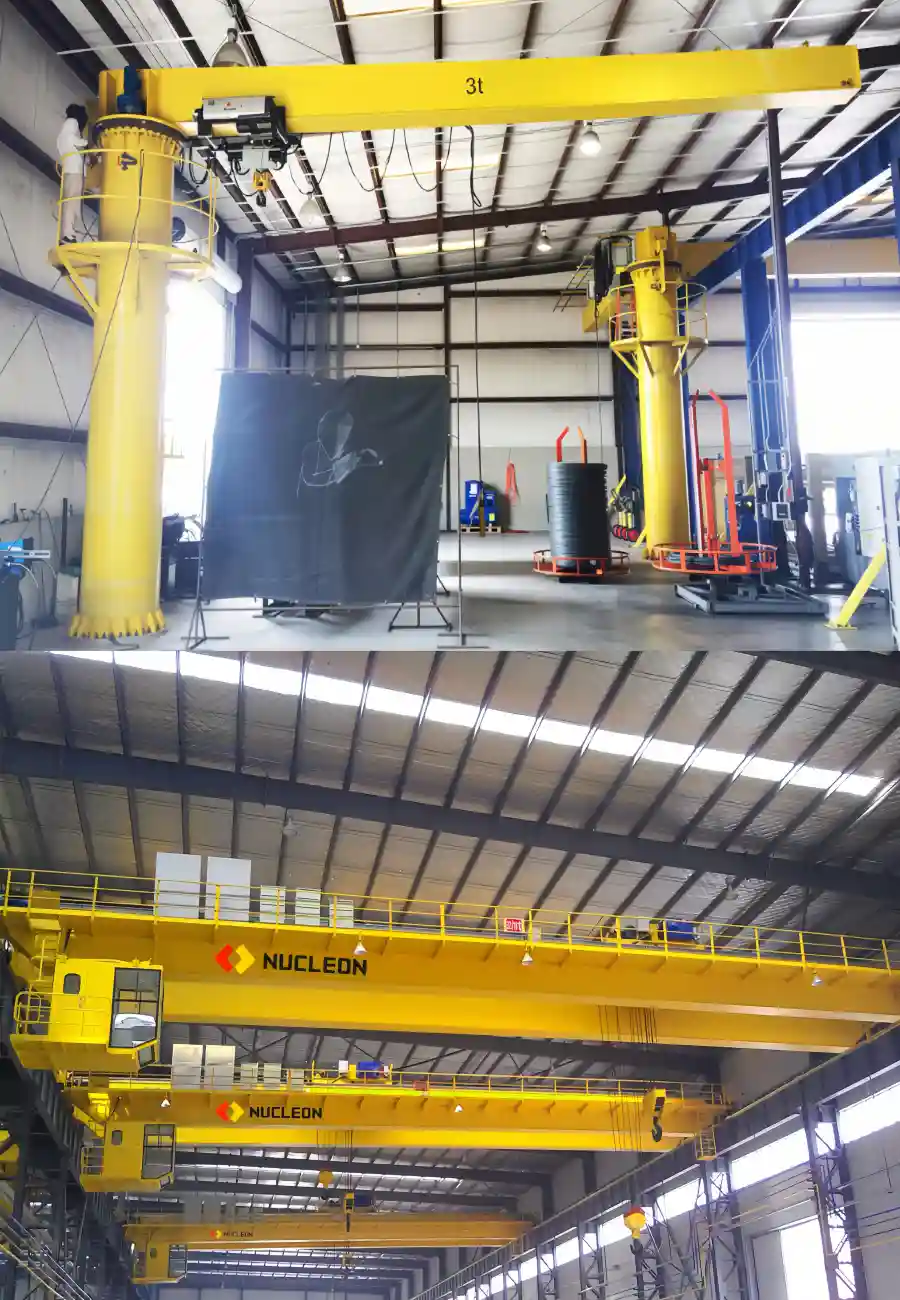
While overhead cranes are essential for moving loads across vast distances, jib cranes excel in localized efficiency.
An overhead crane might take several minutes to travel across a massive warehouse to pick up a load, causing bottlenecks. A jib crane is always exactly where the worker needs it. Furthermore, jib cranes are significantly cheaper to install, require no complex building structural modifications, and are much easier to maintain. In many modern facilities, jib cranes and overhead cranes work side-by-side, complementing each other perfectly.
5. What to Consider Before Installation
Before purchasing a floor mounted slewing jib crane, keep these crucial factors in mind:
●Foundation Requirements: Because the crane is anchored to the floor, it requires a properly poured and cured concrete foundation to handle the dynamic lifting forces. You cannot simply bolt it to a thin slab.
●Hadroom Clearance: Ensure there is enough vertical space above the mast for the arm to rotate freely without hitting overhead pipes, lights, or other cranes.
●Lifting Capacity & Reach: Carefully calculate the maximum weight you need to lift and the furthest distance the hook needs to reach. Remember that lifting capacity decreases as the load moves further out on the arm.
●Power & Rotation: Decide if you need manual push rotation (for lighter loads) or motorized slewing (for heavier, frequent use). Also, ensure power supply for the hoist is properly routed, often utilizing a festoon cable system along the arm.
Frequently Asked Questions
Q1: How much floor space does a floor mounted jib crane take up?
A: Very little. The crane only occupies the small footprint of its vertical mast (pillar). The rest of the crane operates in the air, leaving your valuable floor space completely open for workers, forklifts, and other equipment to move around safely.
Q2: Do I need a special foundation to install it?
A: Yes. Because the crane handles heavy loads, it requires a properly engineered and cured concrete foundation. The exact size and depth of the foundation depend on the crane's lifting capacity and arm length. We provide detailed foundation drawings to guide your civil engineering team.
Q3: Can the crane rotate a full 360 degrees?
A: In most cases, yes. Standard floor mounted slewing jib cranes offer a full 360-degree rotation. However, if the crane is installed close to a wall or other obstacles, we can install mechanical or electrical limit switches to restrict the rotation angle (e.g., to 180° or 270°) to ensure safe operation.
Q4: Is it difficult to rotate the arm manually?
A: Not at all. Our jib cranes are engineered with high-quality slewing bearings that allow the arm to rotate smoothly and effortlessly by hand, even when lifting heavy loads. For maximum efficiency, we also offer motorized slewing options that can be controlled via push-button pendant or wireless remote
Contact Us
●Site Assessment: We can evaluate your workspace to determine the optimal capacity and arm length.
●Custom Solutions: From motorized rotation to specialized hoists, we tailor the crane to your exact needs.
●Expert Support: Comprehensive guidance from selection to installation.