
 English
 Español
 Русский
 العربية
 Français
 Deutsch
 Português
 Tiếng Việt
 ไทย
 Bahasa Indonesia
 Türkçe
 Italiano





The foundry casting crane is a specialized metallurgical lifting system engineered exclusively for transferring molten metal. Unlike general-purpose overhead cranes, its design is governed by the extreme thermal and safety demands of liquid steel handling. These cranes serve as the critical link between refining furnaces (electric arc furnaces, ladle metallurgy stations) and continuous casting machines or ingot molds, operating in environments where radiant heat exceeds 1000°C and duty cycles are continuous.
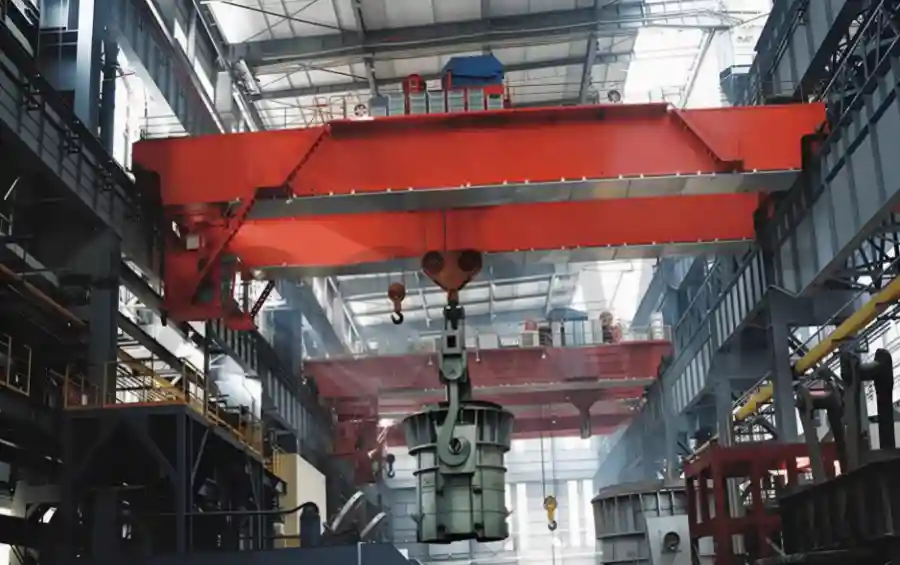
Dual-Trolley Tipping System
The defining mechanical feature of a foundry casting crane is the dual-trolley configuration, which separates lifting and tipping functions:
●Main Trolley: Carries the full ladle weight via a fixed gantry hook that engages the ladle trunnions. The hook-to-trunnion interface is designed to prevent accidental disengagement during transport.
●Auxiliary Trolley: Operates independently on the same bridge girder, equipped with a dedicated tipping hoist. This trolley connects to the ladle's tipping yoke, providing the mechanical leverage to control pour angle and flow rate without destabilizing the main hoist.
For capacities exceeding 100 tons, four-girder or six-track configurations distribute the concentrated ladle load across multiple rails, reducing wheel pressure and extending runway rail life.
Redundant Hoist Safety Architecture
Dropping a molten metal ladle is catastrophic. Foundry casting cranes implement multiple safety redundancies beyond standard crane design:
●Dual Braking Systems: The main hoist features both a primary service brake and a secondary emergency safety brake. The emergency brake is designed to engage automatically upon power loss or primary brake failure, holding the load without electrical power.
●Planetary Gearbox Design: High-capacity casting cranes often use planetary reducers. This configuration allows the hoist to maintain limited lifting capability even if one motor fails, enabling the operator to safely lower the ladle to a secure position before maintenance.
●Real-Time Load Monitoring: Integrated load cells provide continuous weight display in the operator cabin, preventing overload during the dynamic pouring process when weight distribution shifts.
●Thermal and Environmental Protection
Standard crane components degrade rapidly in casting environments. Foundry casting cranes incorporate specific thermal management:
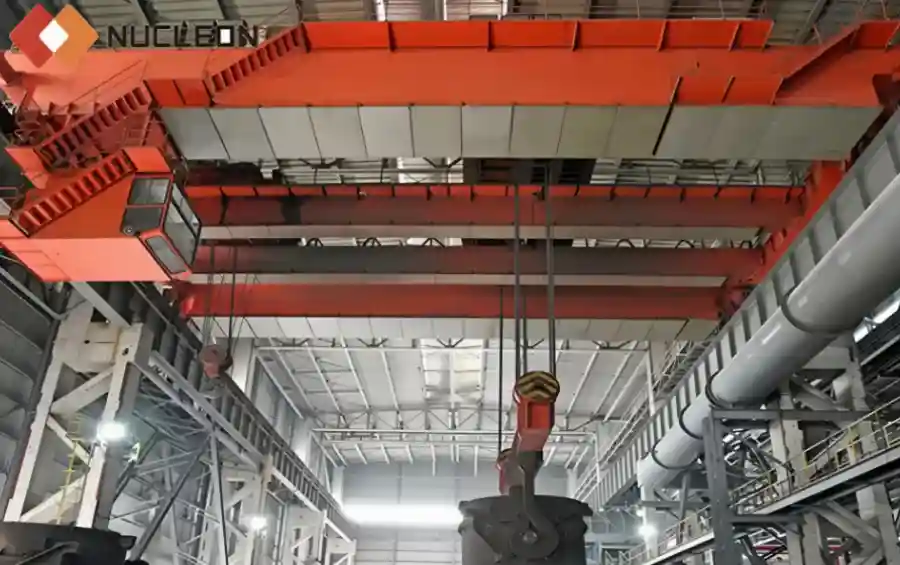
●Thermal Insulation Barriers: Heavy-duty insulation boards are installed beneath the main girders and above hoisting mechanisms, shielding structural steel and wire ropes from direct radiant heat.
●High-Temperature Wire Ropes: Standard lubricants burn out near molten metal. Casting cranes use wire ropes with solid cores or high-temperature synthetic lubricants rated for continuous radiant heat exposure.
●Elevated Electrical Enclosures: Control cabinets and motors are mounted on top of main girders, maximizing distance from the heat source. Enclosures feature IP54/IP55 ratings with positive-pressure ventilation to prevent ingress of conductive metal dust.
Procurement Specifications
When specifying a foundry casting crane, alignment with metallurgical process requirements is essential:
●Working Class: Casting operations require A7 or A8 duty classification (FEM/ISO). Underspecifying this parameter results in premature motor and gearbox failure due to thermal overload and continuous cycling.
●Compliance Standards: Equipment must meet JB/T7688.1-95 or equivalent metallurgical crane standards, which specify enhanced safety factors for hooks, wire ropes, and structural welds in molten metal service.
●Cabin Thermal Management: The operator cabin requires dedicated cooling (air conditioning or forced ventilation with filtration) to maintain safe operating temperatures and protect control electronics from heat soak.
Frequently Asked Questions
Q1: Why do foundry casting cranes use two trolleys?
A: The dual-trolley system separates lifting from tipping. The main trolley supports ladle weight, while the auxiliary trolley provides controlled tipping leverage. This prevents the dynamic forces of pouring from affecting hoist stability.
Q2: What working class is required for casting cranes?
A: A7 or A8 is standard. Molten metal handling is continuous, high-intensity operation with minimal idle time. Lower duty classes cannot withstand the thermal and mechanical stress.
Q3: Can standard overhead cranes handle molten metal?
A: No. Standard cranes lack dual-braking redundancy, thermal shielding, high-temperature wire ropes, and the dual-trolley tipping mechanism required for safe casting operations. Using standard equipment for molten metal violates metallurgical safety standards.