

 English
 Español
 Русский
 العربية
 Français
 Deutsch
 Português
 Tiếng Việt
 ไทย
ไทย
 Bahasa Indonesia
 Türkçe
 Italiano





1. Core Functionality: What is a Marine Boat Hoist?
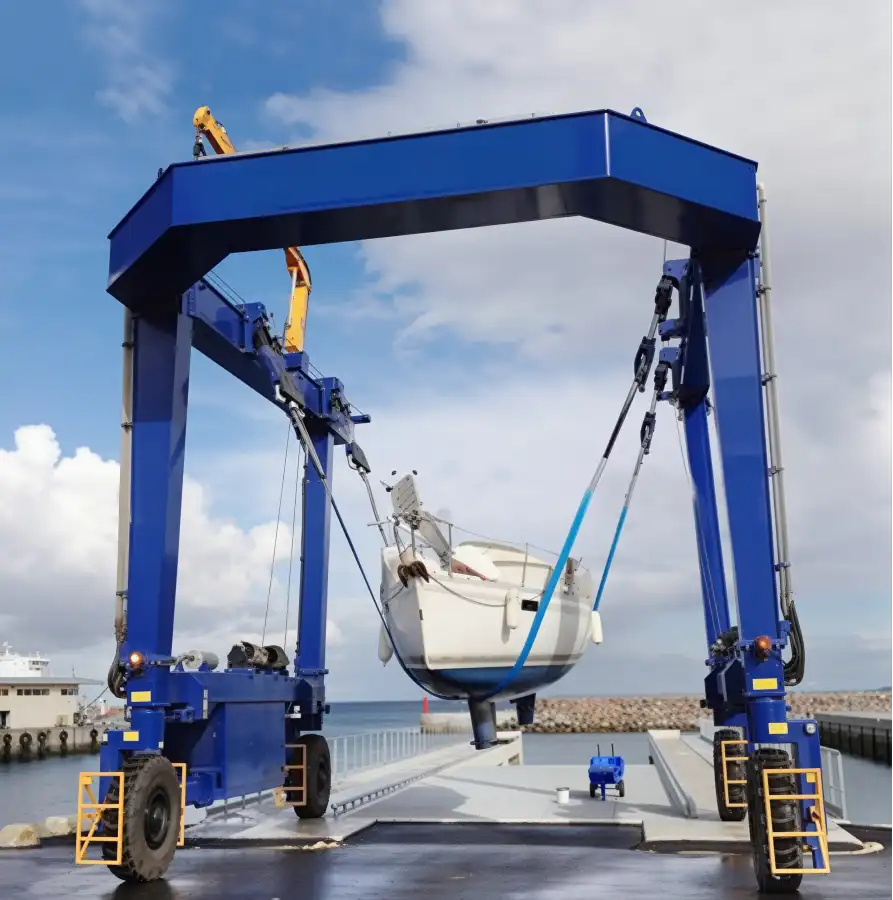
At its most fundamental level, a marine boat hoist is a self-propelled, mobile crane equipped with a robust "U-shaped" framework. Unlike traditional stationary cranes, it can drive directly over a vessel in the water, lower heavy-duty adjustable slings beneath the hull, and lift the craft entirely out of the water. Once lifted, the hoist transports the vessel to maintenance bays, dry storage racks, or launch sites. This mobility eliminates the need for fixed drydocks, drastically optimizing yard space and operational turnaround times.
2. Advanced Technical Architecture & Control Systems
For engineering professionals and technical buyers, understanding the underlying mechanics of a marine boat hoist is critical. Modern hoists are marvels of structural and control engineering:
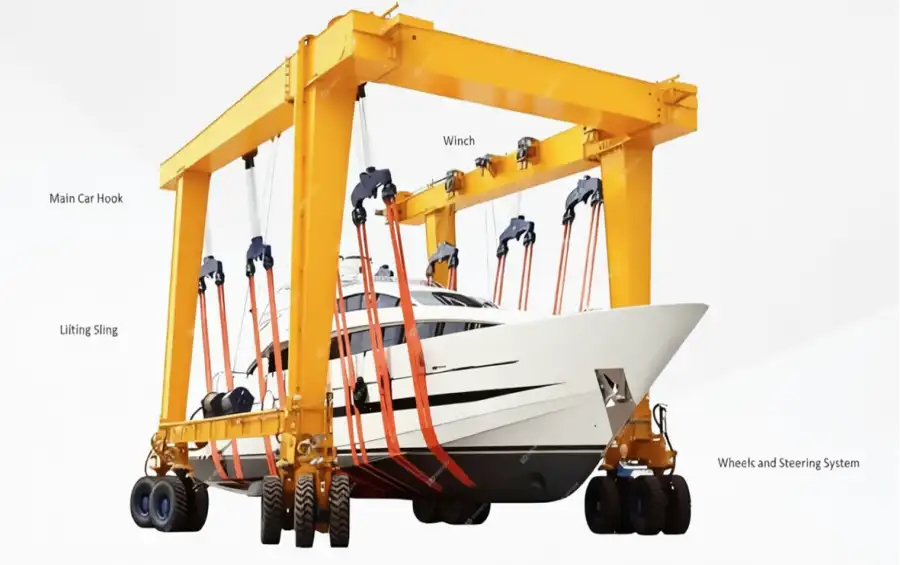
●Multi-Point Synchronous Lifting: A standard marine hoist does not lift from a single point. It utilizes multiple lifting points (often 4 winches, but can be configured with up to 32 lifting points for complex hulls). Advanced systems employ synchronous detection and feedback control. This ensures that all lifting straps rise at the exact same millimeter-per-minute rate, preventing torsional stress on the vessel's hull.
●Complex Road Gantry Internal Force Release: Marine yards often feature uneven concrete or slipways. High-end hoists utilize an articulated pivot trunnion system and flexible steering control. This technology allows the massive steel frame to articulate and release internal stresses when traversing uneven terrain, ensuring the load remains perfectly balanced and the structural integrity of the gantry is maintained.
●Sophisticated Steering Kinematics: Maneuvering a 50-ton machine in a tight marina requires precise steering geometries. Modern hoists offer multiple steering modes, including Ackerman steering (for road-like turning), 4-wheel coordinated steering, and in-place pivot steering (zero-radius turning). This allows the operator to rotate the crane 360 degrees within its own footprint.
●Tire Non-Slip & Traction Technology: Lifting heavy loads requires immense traction. Advanced hoists integrate tire non-slip technology and hydraulic weight distribution systems to prevent wheel spin during the critical lifting phase, especially on wet slipways.
3. Operational Workflow & Hydrodynamic Considerations
The operation of a marine boat hoist is a precise sequence that requires understanding both mechanical limits and hydrodynamics:
●Slipway Entry & Buoyancy Management: When retrieving a boat via a slipway, the hoist must be driven into the water to a depth where the vessel can float between the side frames. Operators must account for the vessel's draft and the buoyancy of the water to ensure the slings can be rigged without the hull scraping the ramp.
●Center of Gravity (CG) Alignment: Proper sling placement is critical. Straps must be positioned to perfectly align with the boat’s center of gravity. An unbalanced lift can cause the vessel to tilt dangerously once it breaks the surface tension of the water.
●Controlled Ascent & Descent: Lifting speeds are deliberately slow (typically around 1 meter per minute under load). This prevents sudden dynamic shock loads on the crane's wire ropes and protects the delicate fiberglass or aluminum hulls of modern yachts.
4. Strategic Advantages for Maritime Facilities
●Yard Space Maximization: By efficiently stacking and storing vessels on land, facilities can increase their storage capacity by up to 300% compared to wet slips.
●Environmental Compliance: Land-based maintenance allows for the complete containment of sandblasting grit, toxic anti-fouling paint, and bilge runoff, ensuring compliance with strict maritime environmental regulations.
●Versatility: Beyond hauling boats, these hoists can be fitted with specialized lifting beams to handle heavy marine engines, caissons, and shipyard fabrication materials.
FAQ
Q1: How does a marine hoist prevent structural damage to the gantry on uneven ground?
A: Through a combination of an articulated pivot trunnion system and complex road internal force release technology. This allows the rigid steel frame to flex slightly and redistribute stress when wheels encounter uneven terrain, preventing structural fatigue.
Q2: Can a marine boat hoist be used in amphibious (direct sea) environments?
A: Yes. Specialized amphibious travel lifts are engineered with galvanized structures and waterproofed electrical systems, allowing them to drive directly into the open sea to retrieve vessels without needing a concrete slipway.
Q3: What happens if a tire blows out while the hoist is carrying a heavy load?
A: Safety is paramount. Marine hoists are equipped with rim supports (backup steel rims). If a tire loses pressure or blows out, the rim support catches the load, preventing the crane from tipping or dropping the vessel.
Contact Us
●Yard Topography Analysis: Send us your facility layout and slipway gradients for a custom operational simulation.
●Technical Sizing: Expert guidance on lifting capacities, steering kinematics, and sling configurations.
●Global Installation & Training: Comprehensive support from factory testing to on-site operator training.