
 English
 Español
 Русский
 العربية
 Français
 Deutsch
 Português
 Tiếng Việt
 ไทย
ไทย
 Bahasa Indonesia
 Türkçe
 Italiano





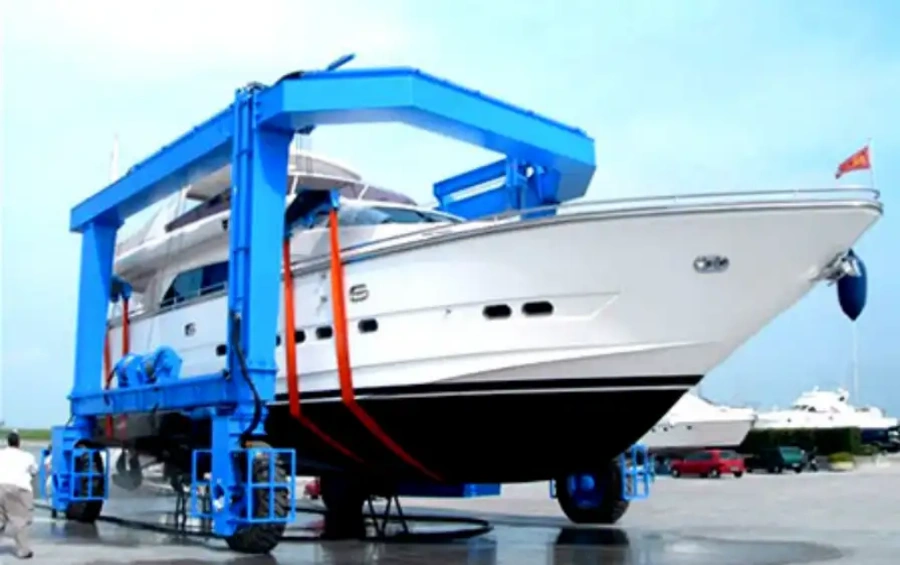
For boat owners, shipyards, and marina operators, getting a vessel out of the water is often the most challenging part of the job. Whether it's for routine hull cleaning, anti-fouling painting, or winter storage, the traditional method of using travel lifts or slipways can be time-consuming and labor-intensive.
Enter the Marine Boat Hoist (often referred to as a Davit Crane or Boat Lifting Crane). This specialized piece of equipment is designed to simplify the process of lifting boats vertically, offering a compact, cost-effective, and highly efficient alternative to massive travel lifts.
What Exactly is a Marine Boat Hoist?
Unlike standard industrial cranes found in factories, a Marine Boat Hoist is engineered specifically for the maritime environment. It is typically a slewing jib crane or a fixed gantry system installed on a concrete pier or dock.
Its primary function is to lift boats straight up out of the water and rotate them onto the land (or vice versa).
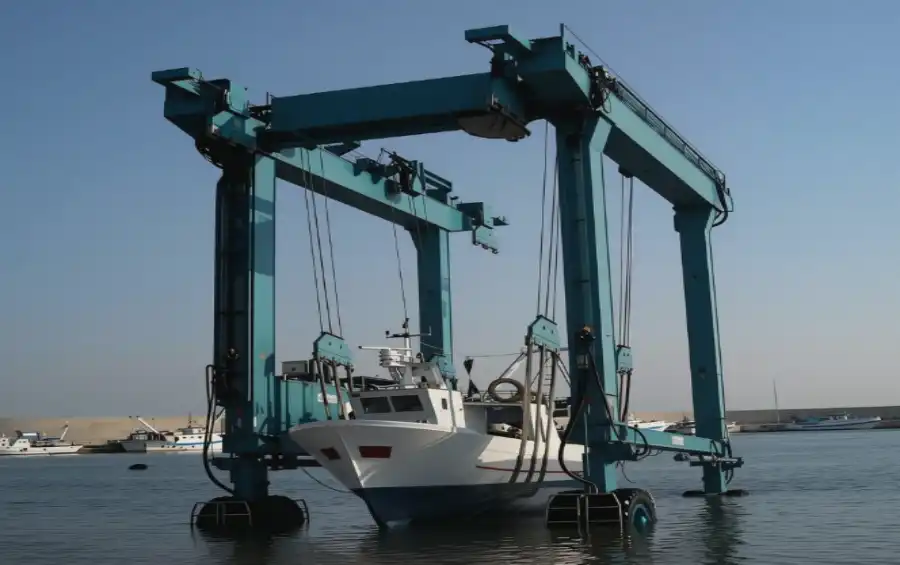
Key Characteristics:
●Vertical Lifting: It lifts the boat vertically, minimizing the risk of hull damage compared to dragging it up a ramp.
●Compact Footprint: It occupies very little space on the dock, leaving room for other boats and equipment.
●Corrosion Resistance: Built to withstand saltwater, humidity, and UV radiation.
How It Works: The Anatomy of a Boat Lift?
To understand why this equipment is so effective, let's break down its core components:
●1. The Mast (Column): The vertical steel pillar anchored to the ground. It bears the entire weight of the vessel.
●2. The Boom (Jib): The horizontal arm that extends over the water. This determines the "reach" or how far out into the water the crane can lift.
●3. Slewing Mechanism: The gearbox that allows the boom to rotate (usually 360° or 180°). This is crucial for swinging the boat from the water onto a trailer or boat stand on the land.
●4. Electric Wire Rope Hoist: The lifting unit that travels along the boom. It uses heavy-duty slings or straps to cradle the boat's hull.
●5. Corrosion-Protected Motor: The heart of the machine. In a marine environment, the motor and electrical box must be treated with special coatings (like zinc-rich paint) or made of stainless steel to prevent rust.
Surviving the Elements: Corrosion Protection
The biggest enemy of any marine equipment is salt spray. A standard crane used in a marine environment will rust within months. A proper Marine Boat Hoist must feature:
●Hot-Dip Galvanizing: The steel structure is dipped in molten zinc, providing a barrier that lasts for decades.
●Marine-Grade Paint: Multi-layer epoxy and polyurethane paint systems.
●Stainless Steel Fasteners: All bolts and nuts should be Grade 304 or 316 stainless steel.
●IP55/IP65 Electrical Rating: Electrical boxes must be tightly sealed against water ingress.
Selection Guide: What to Consider Before Buying
Before purchasing a Marine Boat Hoist, you need to calculate three main parameters:
●1. Safe Working Load (SWL): Don't just look at the boat's weight. You must account for the weight of the boat + the engine + full fuel tanks + water in the tanks + the weight of the lifting beams and slings. Always add a 20% safety margin.
●2. Span / Reach: How far does the boom need to extend to reach the water? Be careful of "under-hook height" — ensure the boat is lifted high enough to clear the dock wall.
●3. Rotation Angle: Do you need a full 360° rotation, or is 180° sufficient? If there is a wall behind the crane, a 180° limitation with limit switches is safer.
Frequently Asked Questions
Q1: Can I install this on a floating dock?
Generally, no. Marine Boat Hoists require a solid, stable concrete foundation to resist the overturning moment (the force trying to tip the crane over) when lifting a heavy boat. Floating docks are too unstable for this type of heavy lifting.
Q2: How do I prevent the slings from damaging my boat's gel coat?
We recommend using broad, flat lifting straps rather than wire ropes for direct contact. Additionally, using a "spreader beam" helps keep the straps vertical, preventing them from squeezing the hull too tightly.
Q3: Is the electric hoist waterproof?
The hoist is designed to be "weatherproof" (IP55), meaning it can handle rain and sea spray. However, it is not designed to be submerged underwater. If the area is prone to flooding, the control panel should be mounted higher up on the column.
Q4: Can I operate it wirelessly?
Yes. Most modern Marine Boat Hoists come with an industrial wireless remote control. This allows the operator to stand in the best position to see the boat entering the water, rather than being stuck at a fixed control panel.
Contact Us
Are you looking to upgrade your shipyard's lifting capabilities? Whether you need a 3-ton hoist for a private dock or a 50-ton solution for a commercial repair yard, we have the engineering expertise to design the perfect lifting solution for you.
Don't let difficult launching procedures slow down your business. Contact us today for a free consultation and a customized quote.