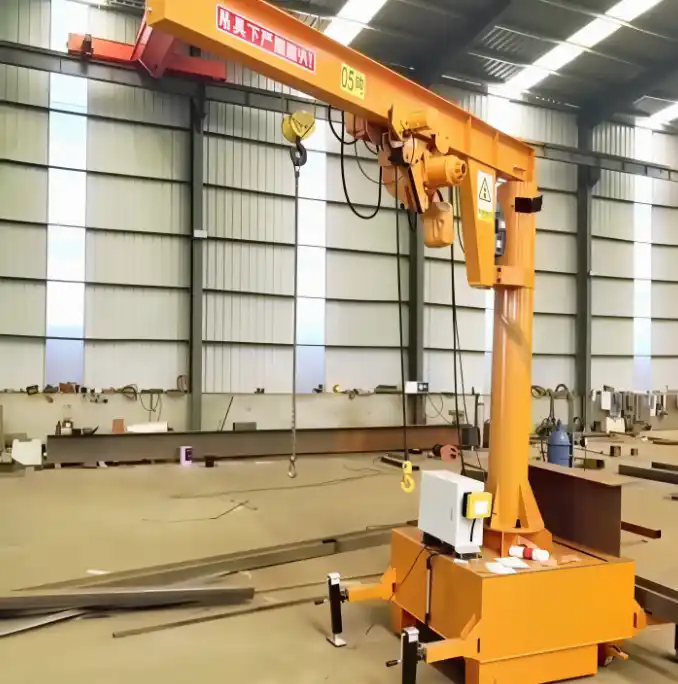







In modern industrial and manufacturing sectors, efficient material handling is crucial for maintaining productivity. While large fixed cranes are excellent for heavy-duty operations, they often lack the flexibility required for dynamic work environments. Enter the Portable Jib Crane (also known as a Mobile Jib Crane). This compact, highly mobile lifting device has become an essential asset for small-to-medium-sized workshops, maintenance stations, and warehouses, offering a perfect balance of maneuverability and cost-effectiveness.
1. What is a Portable Jib Crane?
A portable jib crane is a lightweight, freestanding lifting system designed to be easily moved between different workstations. Unlike traditional fixed jib cranes that require permanent concrete foundations, a portable jib crane is mounted on a heavy-duty base equipped with lockable caster wheels.
The system typically consists of a vertical mast (column), a horizontal jib arm (boom), a hoist and trolley mechanism, and a mobile base. The jib arm can rotate (usually 270° or 360°), while the hoist moves horizontally along the arm and lifts vertically, providing complete three-dimensional material handling within a localized area.
2. When Do You Need a Portable Jib Crane?
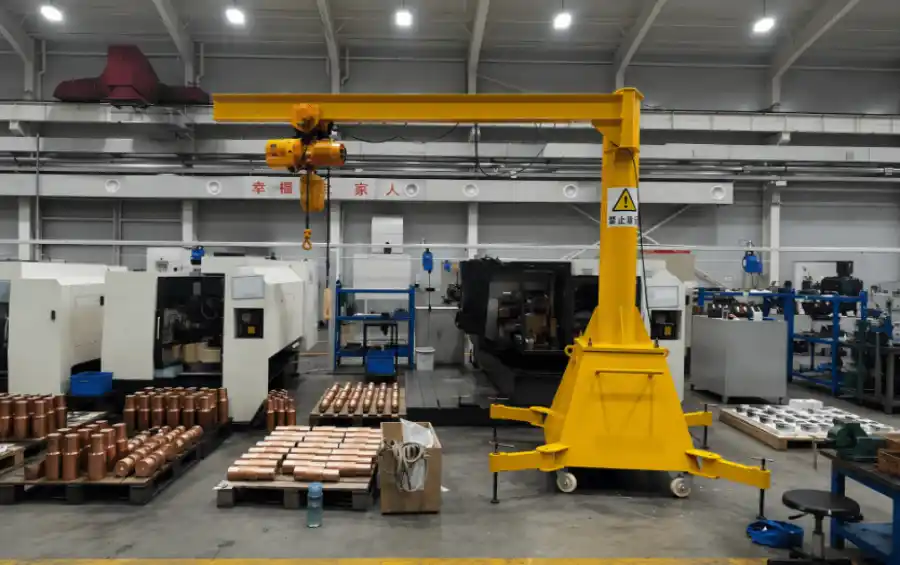
Portable jib cranes are specifically engineered for environments that demand flexibility and adaptability. They are the ideal solution when:
●Workstations Change Frequently: In modular workspaces or assembly lines where the layout is regularly reconfigured to meet production demands.
●Multiple Locations Share Lifting Tasks: When a single lifting device needs to serve several different machines or loading docks throughout the day.
●Space is Limited: In compact workshops where installing a permanent overhead crane or dedicating floor space to a fixed jib crane is not feasible.
●Temporary or Outdoor Lifting is Required: For emergency maintenance, loading goods onto trucks in outdoor yards, or temporary construction sites where permanent infrastructure is unavailable.
3. Key Advantages for Your Facility
Integrating a portable jib crane into your operations delivers immediate benefits:
●Unmatched Flexibility: Easily roll the crane to where the work is, eliminating the need to move heavy materials to a fixed crane.
●Cost-Effective Solution: Reduces the need to purchase multiple fixed cranes for different stations, significantly lowering equipment acquisition costs.
●No Foundation Required: Simple assembly and immediate use. There is no need for costly and time-consuming concrete foundations or structural modifications to your building.
●Space-Saving Design: Its compact footprint allows it to be placed in tight spaces and around obstacles, maximizing usable workspace.
●Enhanced Safety & Ergonomics: Reduces the physical strain of manual lifting, preventing workplace injuries and improving overall operational safety.
4. Critical Technical Parameters
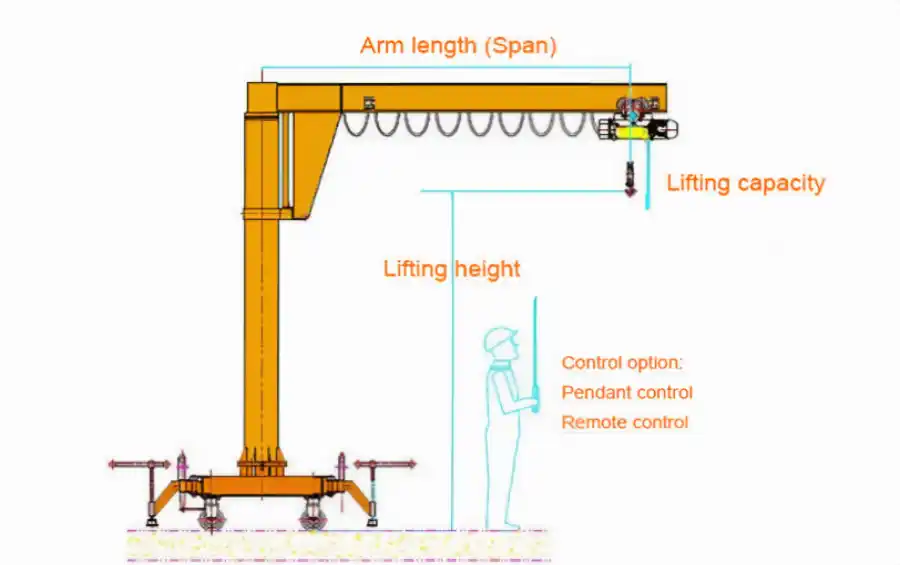
When selecting the right portable jib crane, matching technical specifications to your operational needs is essential:
●Lifting Capacity (SWL): Typically ranges from 0.25 tons to 2 tons. Always select a capacity that accommodates your heaviest anticipated load with a safety margin.
●Lifting Height: The vertical distance the hoist can travel. Standard heights range from 1 to 4 meters, but custom heights are often available.
●Jib Length (Span): Determines the working radius. Common lengths are between 1 and 4 meters. Keep in mind that lifting capacity is rated at the maximum effective radius.
●Rotation Angle: Most portable models offer 270° or full 360° rotation, depending on the base design and workspace constraints.
●Hoisting Mechanism: Choose between electric wire rope hoists, electric chain hoists, or manual chain blocks, depending on your frequency of use and precision requirements.
Frequently Asked Questions
Q1: Can I move the crane while it is lifting a load?
A: No. For safety and stability, a portable jib crane should only be moved when it is completely unloaded. Always lower the load to the ground before relocating the crane.
Q2: Does the floor need to be perfectly flat?
A: Yes. Portable jib cranes should be operated on flat, solid, and level ground. Operating on uneven surfaces can cause the crane to become unstable and create a tipping hazard.
Q3: How do I secure the crane during operation?
A: All high-quality portable jib cranes are equipped with heavy-duty lockable caster wheels. Always engage the wheel locks before lifting any load to ensure the base remains completely stationary.
Contact Us
●Custom Lifting Solutions: Tailored capacity and span configurations for your specific workflow.
●Expert Consultation: Free assessments to help you choose the right mobile crane.
●Global Support: Comprehensive after-sales service and spare parts supply.