
 English
 Español
 Русский
 العربية
 Français
 Deutsch
 Português
 Tiếng Việt
 ไทย
ไทย
 Bahasa Indonesia
 Türkçe
 Italiano





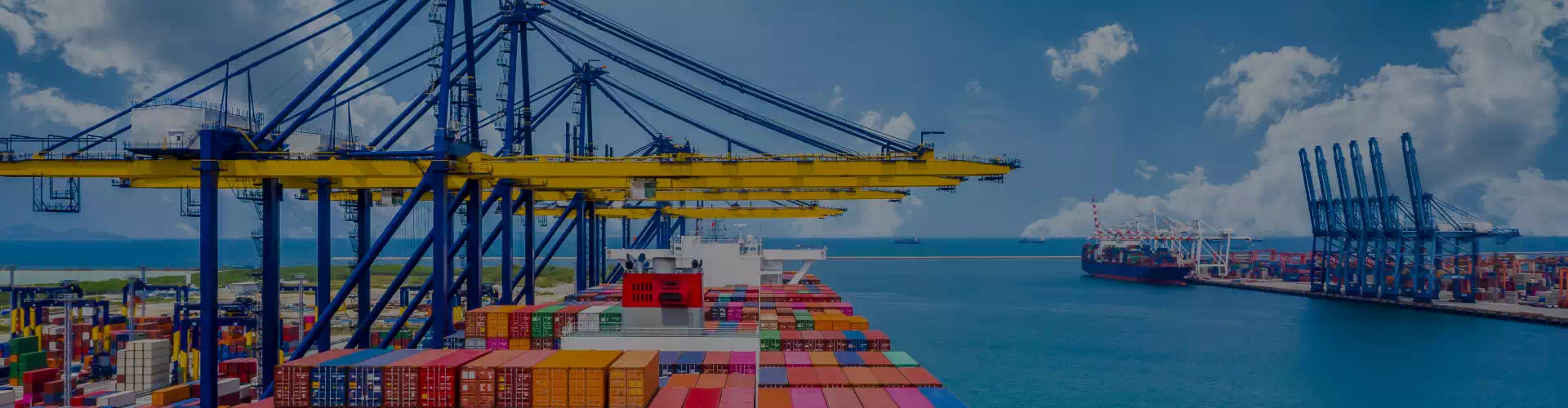
In the high-stakes environments of maritime logistics, shipbuilding, and heavy industrial construction, the demand for reliable, high-capacity lifting equipment is paramount. At the forefront of this sector is the Portal Boom Crane. Characterized by its robust gantry frame and highly flexible boom system, this crane is an indispensable workhorse that seamlessly integrates lifting, rotating, and traveling functions.
This comprehensive guide explores the structural mechanics, core advantages, and diverse applications of portal boom cranes, helping facility managers and port operators optimize their heavy-lifting infrastructure.
1. What is a Portal Boom Crane?
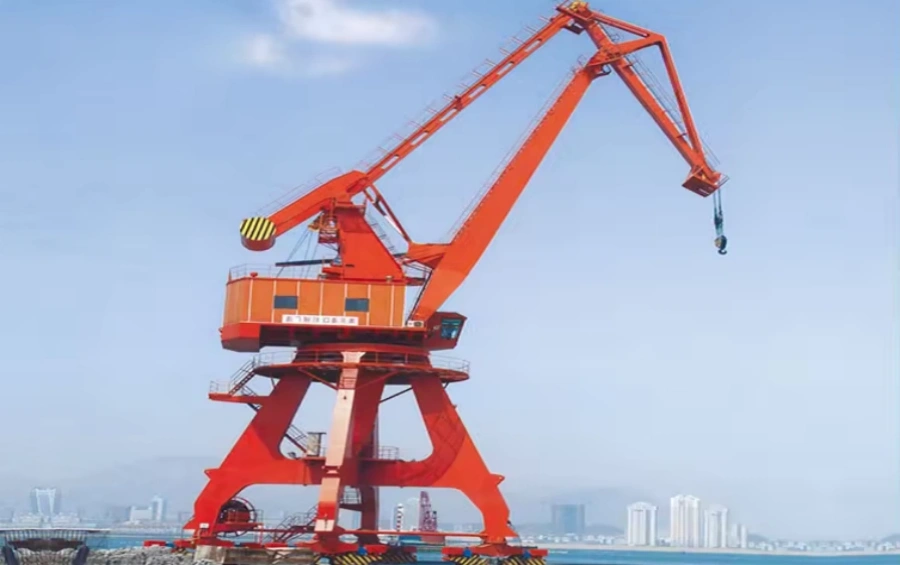
A Portal Boom Crane is a heavy-duty rotary crane distinguished by its portal (door-shaped) gantry base. Unlike traditional cranes that rely on building runways, this equipment travels on ground-level rails. Its defining feature is the combination of a sturdy gantry frame that allows vehicles or trains to pass underneath, and a rotating boom system that provides extensive 360-degree operational coverage.
With lifting capacities ranging from standard 10-ton models to massive 300-ton heavy-lift configurations, these cranes are engineered to handle complex material transshipment tasks with remarkable precision and stability.
2. Core Components and Structural Design
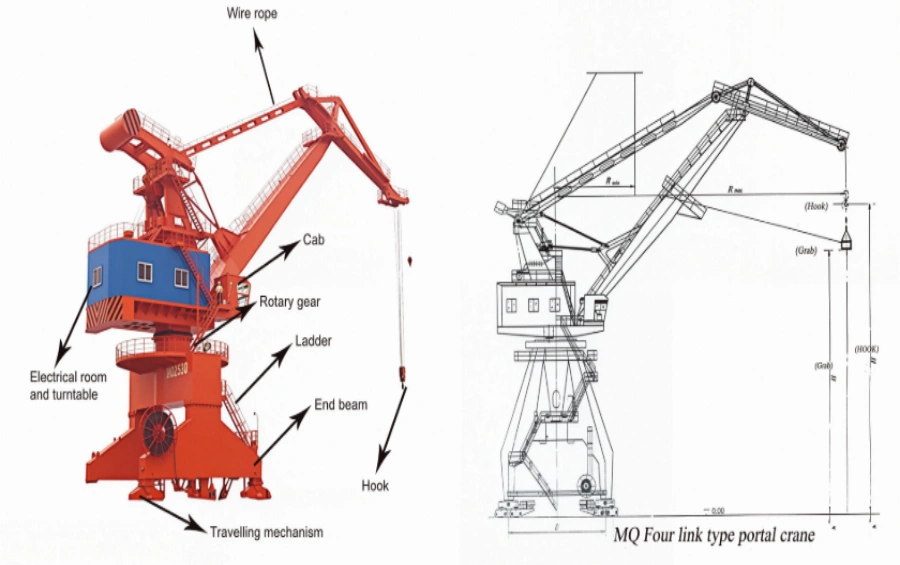
The efficiency of a portal boom crane relies on the seamless integration of several critical subsystems:
●Metal Structure (Gantry Frame): The foundation of the crane, consisting of rigid legs and upper beams. This box-section welded structure provides immense stability and supports the massive overturning moments generated during heavy lifts.
●Boom System & Luffing Mechanism: The crane typically utilizes either a single boom or an advanced four-link combined boom system. The four-link design is highly favored as it ensures the load moves along a near-horizontal trajectory during luffing (boom angle adjustment), minimizing energy waste and enhancing safety.
●Hoisting & Slewing Mechanisms: Equipped with high-performance winches and large slewing bearings, these mechanisms allow for smooth vertical lifting and seamless 360-degree rotation.
●Travel Mechanism: Driven by multiple wheel sets, this system propels the crane along its ground track, often featuring variable frequency drives for precise positioning.
●Advanced Electrical & Safety Systems: Modern portal cranes integrate PLC control, moment limiters, anti-collision systems, and GPS positioning to ensure operational safety and high precision (often within ±5mm to ±10mm).
3. Key Advantages for Heavy Industry
Investing in a portal boom crane delivers transformative operational benefits:
●Unmatched Operational Flexibility: The combination of gantry travel, boom luffing, hoisting, and 360-degree slewing creates a massive, unobstructed working volume. This allows the crane to service ships, shore vehicles, and adjacent storage yards simultaneously.
●High Efficiency & Throughput: Advanced models feature twin-hook systems and rapid acceleration, capable of handling up to 1,200 tons of bulk cargo per hour or processing dozens of containers per hour, significantly reducing vessel turnaround times.
●Space-Saving Accessibility: The open gantry design allows trucks and trains to pass directly beneath the crane, facilitating continuous, collaborative logistics operations without requiring separate staging areas.
●Precision & Safety: Equipped with intelligent safety redundancies, load monitoring, and variable frequency speed control, these cranes ensure safe, millimeter-accurate positioning for delicate heavy-lift assembly tasks.
4. Ideal Applications and Working Environments
Portal boom cranes are highly adaptable and serve as the backbone for several critical sectors:
●Port Terminals & Logistics Hubs: Efficiently transshipping containers, general cargo, and bulk materials between vessels and shore-based transport.
●Shipyards & Ship Repair: Lifting, turning, and precisely assembling massive ship hull blocks and heavy marine components.
●Hydropower & Dam Construction: Handling heavy concrete prefabricated parts, turbines, and steel structures in expansive outdoor construction sites.
●Railway & Intermodal Yards: Facilitating rapid loading and unloading of freight trains, reducing vehicle delays and maintenance costs.
Frequently Asked Questions
Q1: What is the difference between a single-boom and a four-link portal crane?
A: A single-boom crane features a simpler structure, lighter weight, and lower wheel pressure, making it cost-effective for general cargo. A four-link portal crane uses a complex combined boom system to achieve highly accurate horizontal luffing, offering superior stability and efficiency for heavy, continuous-duty operations like container handling.
Q2: Can a portal boom crane operate in harsh marine environments?
A: Yes. They are specifically engineered for coastal conditions. High-quality portal cranes feature C5-M grade corrosion resistance, IP56-rated motors capable of operating in temperatures from -30°C to 55°C, and robust wind-clamping systems to withstand severe maritime weather.
Q3: How precise is the load positioning?
A: Modern portal boom cranes equipped with PLC control, GPS, and encoder positioning systems can achieve highly accurate load spotting, often reaching precision levels of ±5mm to ±10mm, which is critical for precision assembly and container handling.
Contact Us
●Custom Load & Site Analysis: We’ll evaluate your throughput requirements to recommend the optimal capacity, span, and boom configuration.
●Tailored Engineering: From specialized spreaders to automated control systems, we customize every crane to your exact workflow.
●Comprehensive Support: Enjoy peace of mind with our expert installation guidance, operator training, and global spare parts supply.