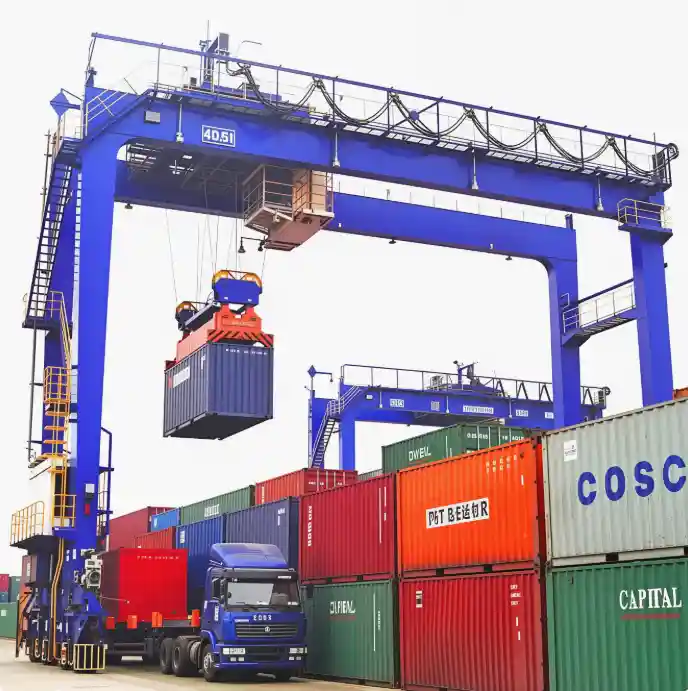






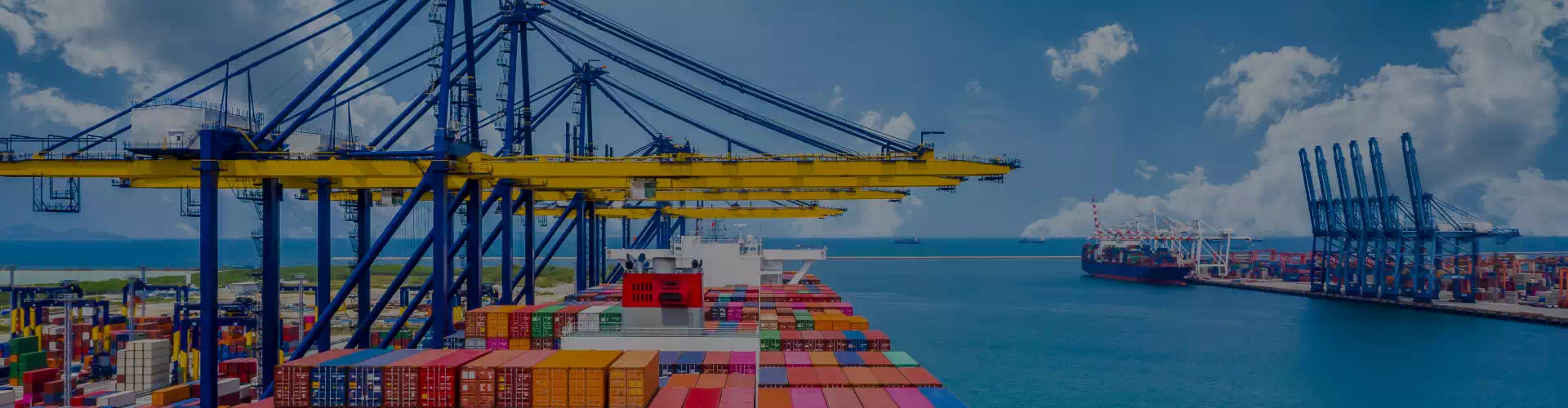
If you have ever visited a busy shipping port or a massive logistics hub, you have likely seen these giant, towering machines. The Rubber Tyred Container Gantry Crane, commonly known in the industry as RTG, is the ultimate workhorse of the container yard.
1. What is an RTG? (The Basics)
In simple terms, an RTG is a massive, mobile crane used to stack, load, and unload standard shipping containers. Unlike traditional cranes that are locked onto fixed steel rails, an RTG rolls on heavy-duty rubber tires. This gives it a superpower: mobility. It can drive across the yard, turn corners, and even switch between different container blocks. Think of it as a highly precise, heavy-lifting forklift that can stack containers up to six or eight layers high!

2. Core Mechanics: The Anatomy of an RTG
While they look simple from the outside, RTGs are marvels of heavy-duty engineering. Understanding their mechanical structure is key to appreciating their capabilities:
●Flexible Steering & Travel Mechanism: The crane is supported by 4, 8, or 16 large tubeless tires. To navigate tight spaces, it features a 0° to 90° steering mechanism. This allows the crane to perform a "crab steering" (diagonal movement) or even a zero-radius 360-degree spin, making it incredibly agile in crowded yards.
●Advanced Hoisting & Spreader System: The heart of the crane is its telescopic spreader, capable of lifting 20ft, 40ft, and 45ft containers. To prevent the heavy container from swinging dangerously during high-speed trolley movements, modern RTGs utilize electrical anti-sway systems and micro-rotation devices for millimeter-accurate landing.
●Intelligent Control Architecture: The era of basic relay controls is over. Today’s RTGs are driven by PLC (Programmable Logic Controller) and AC variable frequency drives. This allows for seamless speed regulation and constant power control, automatically adjusting the lifting speed based on the exact weight of the container.
3. The Technological Leap: Power Systems & Automation
As ports become smarter and greener, the RTG has undergone a massive technological evolution. This is where the true depth of the equipment lies:
●Hybrid & Green Power Solutions: Traditional RTGs rely on diesel generators, which can be noisy and emit carbon. Modern fleets are rapidly transitioning to Diesel-Electric Hybrid systems utilizing Super Capacitors. These capacitors act as a buffer: they capture and store the massive regenerative energy generated when a heavy container is lowered, and release it instantly during lifting. This drastically reduces fuel consumption, eliminates the "black smoke" during acceleration, and lowers the required engine capacity. Furthermore, pure electric RTGs (powered by busbars) and even Hydrogen Fuel Cell models are now entering the market.
●The Rise of ARTG (Automated RTG): Driven by the global push for smart logistics, RTGs are increasingly being upgraded with DGPS (Differential GPS) and laser positioning systems. This transforms a manually operated RTG into an ARTG, capable of fully autonomous stacking, truck recognition, and remote-control operation from a centralized, air-conditioned cabin miles away.
4. RTG vs. RMG: Making the Right Yard Investment
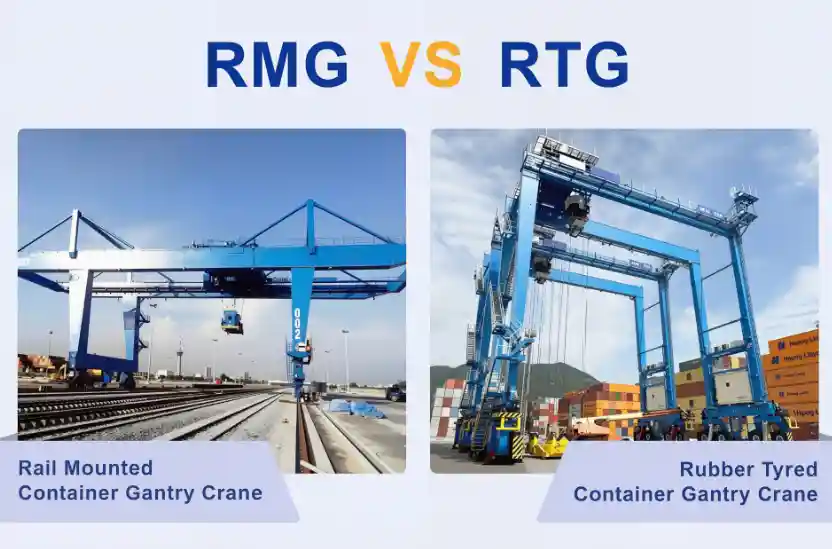
When designing a container terminal, operators must choose between RTGs and Rail Mounted Gantry cranes (RMGs). While RMGs offer high automation and lower maintenance, RTGs remain the king of flexibility. Because they do not require fixed ground rails, RTGs allow terminals to easily reconfigure their yard layout, expand storage capacity, or shift traffic flows without massive civil engineering costs.
Frequently Asked Questions
Q1: How does an RTG prevent collisions in a busy yard?
A: Safety is paramount. RTGs are equipped with multi-layered protection, including manual deviation correction systems, four-corner anti-collision radar devices, and automatic wind-speed monitoring with storm anchors.
Q2: Can an RTG handle oversized or heavy-lift containers?
A: Yes. While standard RTGs handle 40-50 tons, specialized heavy-lift RTGs can be engineered with capacities of 65 tons or even 120 tons, utilizing multi-rope spreader configurations (e.g., 8-rope or 16-rope systems) for extreme stability.
Q3: What is the lifespan of a modern RTG?
A: With proper maintenance and timely upgrades (such as converting a diesel RTG to an electric hybrid), a high-quality RTG can reliably serve a port for 15 to 20 years or more.
Contact Us
●Yard Layout & Equipment Matching: Customized solutions based on your throughput and stacking density requirements.
●Green Retrofitting: Ask us about super-capacitor hybrid upgrades to reduce your carbon footprint and fuel costs.
●Global Lifecycle Support: From installation and PLC programming to 24/7 spare parts supply.