
 English
 Español
 Русский
 العربية
 Français
 Deutsch
 Português
 Tiếng Việt
 ไทย
 Bahasa Indonesia
 Türkçe
 Italiano





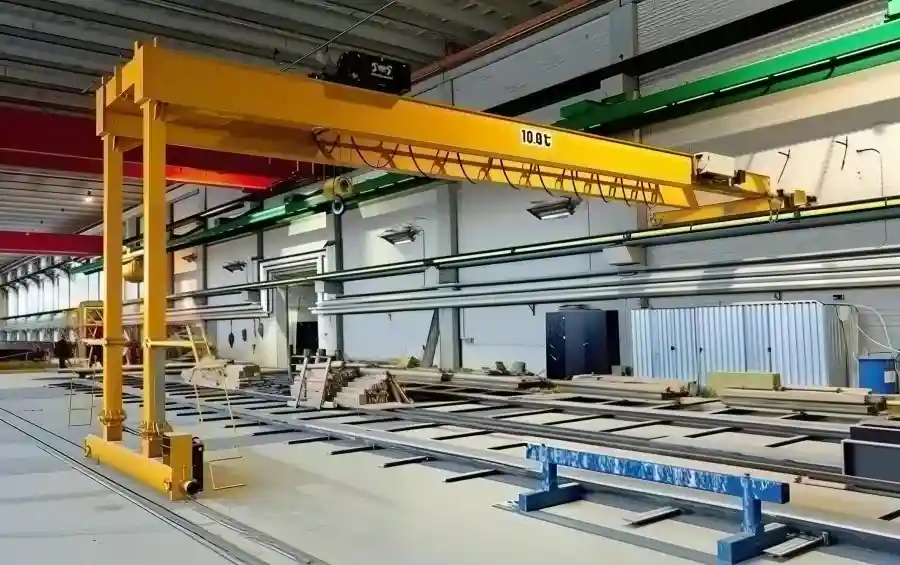
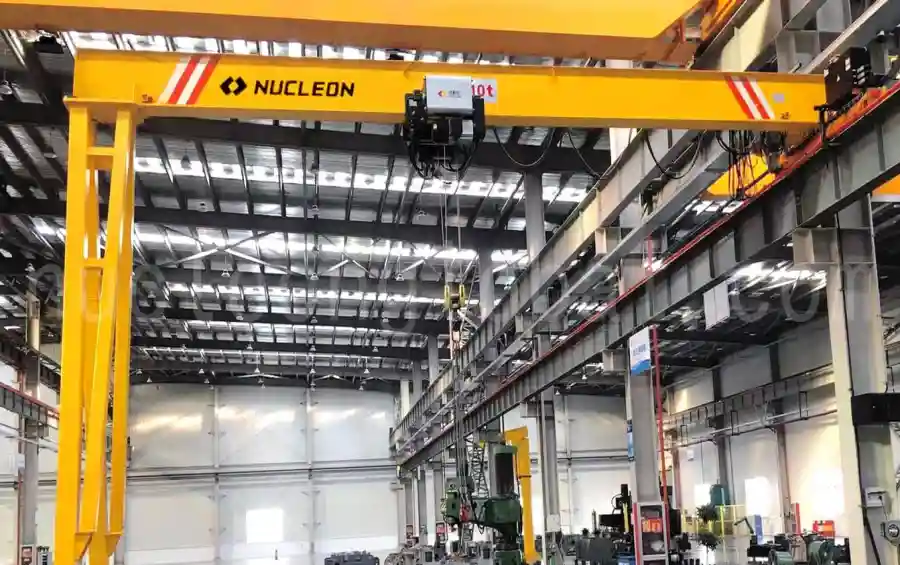
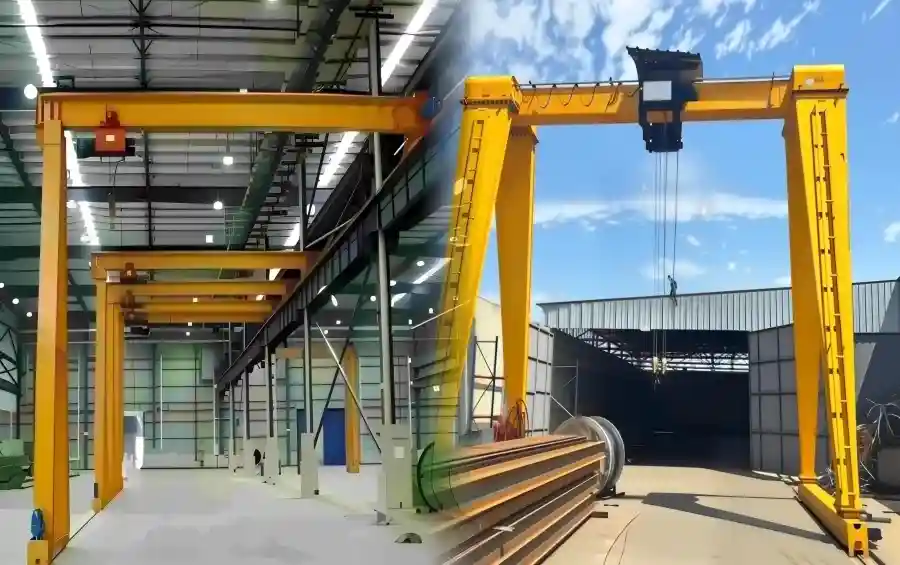
A semi gantry crane is defined by its asymmetric support: one end travels on an elevated runway beam fixed to a building column or wall bracket, while the opposite end is carried by a freestanding leg running on a ground-level rail. This hybrid arrangement delivers the coverage of a bridge crane without requiring a second elevated runway, making it the go-to solution when one side of a facility already has a usable support structure and the other side is open, structurally unsuitable, or prohibitively expensive to reinforce.
The engineering challenge lies in managing the asymmetric load path — the runway-beam side behaves like a conventional bridge crane end truck, while the leg side introduces overturning moments, ground-rail settlement sensitivity, and wind-load vulnerability (for outdoor units). Proper design must address these asymmetries at the structural, drive, and safety-system levels.
When a Semi Gantry Crane Is the Right Choice?
The semi gantry crane occupies a narrow but valuable niche. It is the optimal choice when:
-One side of the working area already has a strong column line or wall: One side of the working area already has a strong column line or wall that can support a runway beam, while the opposite side is open or cannot accommodate a second elevated runway.
-Budget constraints: Budget constraints rule out installing a full two-beam bridge crane, but a freestanding full gantry crane would consume too much floor space or lack the required span.
-Retrofit speed: Retrofit speed is critical — installing one runway beam and one ground rail is significantly faster than constructing a second elevated runway or building a new column grid.
It is not suitable when:
-No existing support: Neither side has an existing support structure and no new column line can be built — a full gantry crane is then the better option.
-Heavy-duty continuous operation: The facility has a complete column grid and demands heavy-duty, continuous operation — a standard double-girder bridge crane offers superior duty class and long-term performance.
-Unstable ground: The ground on the leg side cannot support a stable rail foundation (soft soil, frequent heavy vehicle traffic across the rail path) — ground settlement will cause misalignment and premature wheel wear.
Asymmetric Structural Design: The Core Engineering Challenge
The semi gantry crane's single-leg configuration creates fundamentally different boundary conditions at each end of the main girder. This asymmetry drives every design decision.
Runway-beam side (elevated, conventional):
-End truck with double-flange or single-flange wheels running on an elevated rail.
-Horizontal guide wheels or side rollers engage the rail head or web to resist lateral drift during bridge acceleration.
-The runway beam must be verified for vertical wheel load, lateral force from bridge travel inertia, and deflection limits (typically L/600 to L/800 under full load).
Leg side (ground-level, asymmetric):
-A-frame or portal-frame leg fabricated from welded box sections or H-beams. The leg top connects to the main girder via a pinned or semi-rigid joint.
-The leg base runs on a ground rail via a bogie assembly with multiple wheels to distribute load and accommodate minor rail irregularities.
-Overturning moment: Overturning moment is the critical design parameter. The leg must resist the moment generated by the lifted load acting at a horizontal offset from the leg centerline, plus wind load (outdoor) and bridge travel inertia. Stability is achieved through a wide leg base, outrigger plates, or counterweight (rare, adds complexity).
-Rail clamping devices: Rail clamping devices (manual or automatic) are mandatory for outdoor installations. Without them, wind can push the crane along the rail when parked, potentially derailing the leg bogie.
Main girder (spanning the asymmetry):
-Single girder (box or I-beam) for capacities up to ~20t; double girder for heavier capacities or longer spans.
-Torsional loading: The girder experiences torsional loading due to the asymmetric support — the runway-beam side is laterally restrained by the elevated rail, while the leg side has limited lateral stiffness. Box girders offer superior torsional rigidity compared to I-beams and are preferred for spans over 15m.
-Girder camber must be pre-calculated to compensate for deflection under load, accounting for the different support stiffness at each end.
Drive System: Synchronization Across Asymmetric Supports
Bridge travel drive configuration is critical to prevent skewing — the crane twisting on the runway due to unequal travel resistance at the two ends.
-Single-end drive: Single-end drive (driving only the runway-beam side) is acceptable for small capacities (≤10t) and short spans (≤15m), where leg-side rolling resistance is low and skewing forces are minimal.
-Dual-end drive: Dual-end drive (driving both the runway-beam end truck and the leg bogie) is strongly recommended for larger capacities or longer spans. The two drive units must be electronically synchronized via VFD control to maintain equal travel speed and prevent structural binding.
-VFD control: VFD control is not optional for dual-end drive systems. It provides soft start/stop, adjustable acceleration ramps, and precise speed matching between the two drive ends. Without VFD synchronization, mechanical binding can damage wheel flanges, rails, and the leg-to-girder connection.
-Conductor system: Power is typically fed via a cable festoon system running along the runway-beam side. For long spans, a conductor bar system on the runway beam is more reliable. The leg side is powered through a trailing cable from the girder to the leg bogie.
Safety Systems Specific to Semi Gantry Cranes
Beyond standard crane safety devices (overload limiter, limit switches, emergency stop), semi gantry cranes require several product-specific safety measures:
-Rail clamps / storm anchors (outdoor units): Mechanically lock the leg bogie to the ground rail when the crane is parked. Can be manual (hand-operated screw clamp) or automatic (spring-loaded, released by hydraulic or electric actuator). Automatic clamps are recommended for cranes that are frequently moved or operated in areas with unpredictable wind gusts.
-Leg-side derailment guards: Physical stops or guard rails at both ends of the ground rail travel path to prevent tahe leg bogie from running off the rail in case of limit switch failure.
-Skew detection (dual-end drive systems): Sensors monitor the angular deviation between the runway-beam end truck and the leg bogie. If skew exceeds a preset threshold (typically 1–2 degrees), the system alerts the operator or automatically stops travel to prevent structural damage.
-Ground rail obstruction detection: For outdoor yards with vehicle traffic, photoelectric sensors or physical bumpers can detect obstacles on the ground rail path and halt leg-side travel.
Typical Applications: Where the Asymmetric Design Delivers Value
1. Existing workshop retrofit (highest-value application):
A fabrication shop has a robust column line along one wall but an open floor on the opposite side. Installing a second elevated runway would require new columns, foundation work, and weeks of downtime. A semi gantry crane uses the existing column for the runway-beam side and adds a single ground rail on the open side. Installation: 3–5 days, minimal production disruption.
2. Outdoor steel stockyard or pipe yard:
One side of the yard is bounded by a warehouse wall; the other side opens to a truck loading area. The semi gantry crane handles steel plates, pipes, or structural sections. The ground rail is embedded in a concrete apron, with storm anchors at regular intervals.
3. Shipbuilding assembly bay:
One side runs along the workshop building; the other side opens to the outdoor assembly area. The crane handles large hull sections, with the leg side providing flexibility for oversized components that extend beyond the building footprint.
4. Precast concrete production hall:
One side is supported by the production hall structure; the other side runs along the casting bed area. The crane handles molds, reinforcement cages, and finished concrete elements. The ground rail must be protected from concrete spillage and washdown water.
5. Railway maintenance depot:
One side runs along the depot building; the other side runs parallel to the railway track. The crane lifts locomotive wheelsets, bogies, or engine components. The ground rail is installed between the depot floor and the track, requiring careful coordination with railway safety clearances.
Frequently Asked Questions
Q: What is the difference between a semi gantry crane and a full gantry crane?
A: A semi gantry crane has one side supported by an elevated runway beam (attached to a building column or wall) and the other side supported by a freestanding leg on a ground rail. A full gantry crane has two freestanding legs, both running on ground rails, and is fully independent of any building structure. The semi gantry crane leverages existing building structure to reduce cost and installation time.
Q: Can a semi gantry crane be installed in an existing building?
A: Yes. This is the most common application. The existing building column or wall supports one side via a runway beam, while a ground rail is installed on the opposite side. A structural engineer must verify that the existing column can support the crane's vertical wheel load and lateral force from bridge travel.
Q: What is the maximum span and capacity?
A: Typical spans range from 5m to 30m, and capacities from 1t to 50t. Larger spans or heavier capacities are possible with custom engineering, but the asymmetric support requires careful structural analysis to manage torsional loading on the girder and overturning moments on the leg.