






Imagine walking into a facility where the air itself feels heavy with unseen risks. In many industrial settings, the atmosphere is saturated with invisible gases, volatile vapors, or fine combustible dust. In such environments, a single spark from a standard piece of machinery could trigger a catastrophic explosion.
This is precisely why explosion-proof bridge cranes exist. They are not merely lifting machines; they are vital safety barriers designed to operate safely where ordinary equipment would be a deadly hazard. For anyone new to industrial safety, understanding how these specialized cranes work is the first step toward appreciating the complex engineering that keeps workers and facilities safe.
What Does It Look Like? Anatomy of an Explosion-Proof Crane
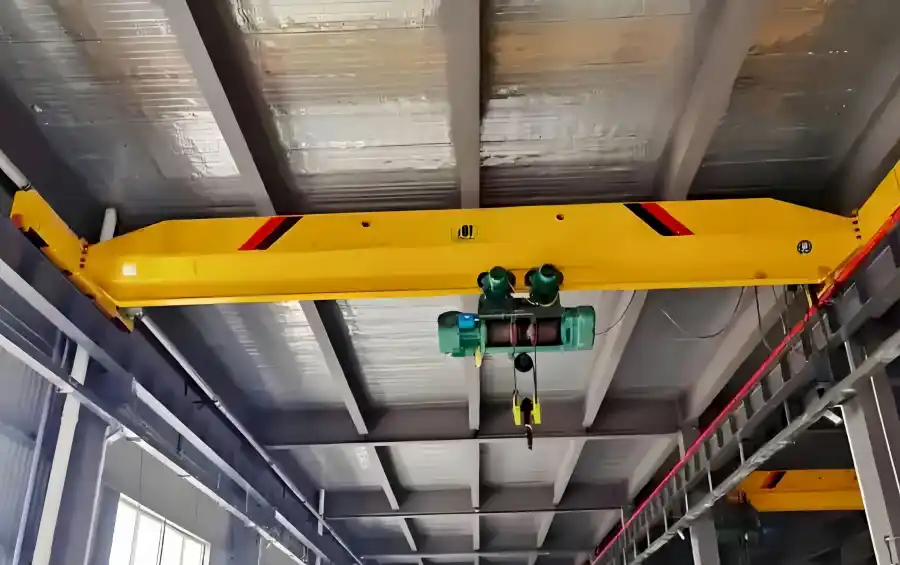
To the untrained eye, an explosion-proof bridge crane might look similar to a standard overhead crane, but a closer inspection reveals critical differences designed to contain or prevent ignition.
The bridge and end beams form the main structural frame. Unlike standard cranes, these structural components are often treated with special anti-static coatings or constructed from non-sparking alloys to prevent friction sparks during movement.
The hoisting mechanism is the heart of the crane. In an explosion-proof model, the electric hoist is completely enclosed. The motor and gearbox are housed in thick, reinforced casings capable of withstanding internal explosions without rupturing.
The explosion-proof motors are a defining feature. They are sealed to prevent internal sparks from escaping and are designed to operate at lower surface temperatures to avoid igniting surrounding gases.
The control boxes and electrical panels are heavily armored. Instead of standard plastic or thin metal enclosures, these are made of thick cast aluminum or stainless steel with flame-proof joints. Any spark generated by internal switches or relays is safely contained within the box.
Finally, the cable and power supply systems are specialized. Standard open-wire systems are replaced with enclosed cable trolleys or rigid conductor bars to prevent arcing. Even the trolley wheels are often made from non-sparking materials like bronze or specialized polymers to eliminate friction sparks against the steel rail.
What Exactly Is It Protecting Against?
To understand the crane’s purpose, one must first understand the “explosion triangle.” An explosion requires three elements to occur simultaneously: a fuel source (flammable gas, vapor, or dust), an oxidizer (usually oxygen in the air), and an ignition source (a spark, hot surface, or static electricity).
In hazardous industrial zones, the fuel and oxidizer are often always present. The explosion-proof crane’s sole mission is to eliminate the third element: the ignition source. It achieves this through containment, isolation, and temperature control. If an electrical short occurs inside the motor, the explosion-proof housing ensures the resulting internal spark cannot escape to ignite the external atmosphere. Furthermore, the crane’s design ensures that no external surface ever gets hot enough to act as an ignition point for the specific gases present in the area.
Decoding Protection Types in Plain English
The technical codes on these cranes can be confusing. Here is a simplified breakdown:
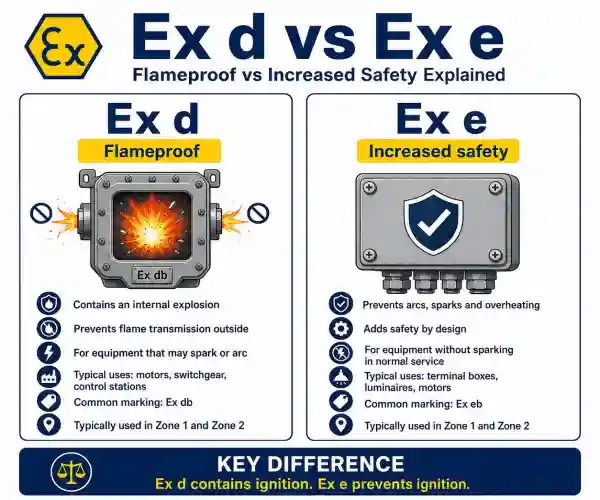
●Ex d (Flameproof): Think of this as a “blast-proof box.” If an explosion happens inside the enclosure, the box is strong enough to contain it, and the joints are designed to cool any escaping gases so they cannot ignite the outside air.
●Ex e (Increased Safety): This is about “prevention through better construction.” It focuses on preventing sparks and hot spots from forming in the first place through superior insulation, tight connections, and careful design, rather than relying on containment.
What to Know Before Use?
Operating an explosion-proof crane requires more than just lifting skills. The installation environment must be strictly verified; placing an Ex-rated crane in a higher-hazard zone than it was designed for is extremely dangerous.
Operator training is paramount. Workers must understand that they cannot use standard tools, flashlights, or communication devices near the crane during operation. Everything in the vicinity must be intrinsically safe.
Regular inspections go beyond checking for wear and tear. Inspectors must verify that flame-proof joints are not damaged, that grounding connections are intact, and that no unauthorized modifications have been made. A common and dangerous misconception is that an explosion-proof crane is “maintenance-free” because it is sealed. In reality, the seals and joints require meticulous care to maintain their protective integrity.
Frequently Asked Questions
1. Can I just paint a standard crane with special anti-static paint to make it explosion-proof?
No. Anti-static paint only addresses surface static electricity. It does nothing to prevent internal electrical sparks, hot motor surfaces, or friction sparks from wheels. True explosion-proofing requires comprehensive internal and external engineering.
2. Why does the crane need to be certified for a specific gas group?
Different gases have different ignition energies and minimum ignition temperatures. A crane certified for methane (a relatively hard-to-ignite gas) might still have surface temperatures or spark energies high enough to ignite hydrogen or acetylene. The certification ensures the crane matches the specific chemical hazards of the area.
3. What happens if the explosion-proof housing gets dented or scratched?
Even a minor dent on a flame-proof (Ex d) enclosure can compromise the flame path. The precise gap between mating surfaces is critical for cooling escaping gases. Any damage typically requires the component to be taken out of service and evaluated or replaced by a certified professional.
Ready to Ensure Safety in Your Facility?
If you are operating in a hazardous environment, choosing the right lifting equipment is not just a matter of efficiency—it is a matter of life and death. Whether you are dealing with flammable gases in a refinery or combustible dust in a grain silo, our team of experts is ready to help you find the perfect explosion-proof solution.
We understand that every facility has unique challenges. That is why we offer personalized consultations to assess your specific needs, from hazardous zone classification to lifting capacity requirements.
Contact us
Let us help you build a safer, more productive workplace.