





In the bustling world of manufacturing, warehousing, and construction, moving heavy loads safely and efficiently is a daily challenge. Enter the Electric Chain Hoist. If you’ve ever seen a compact, motorized machine lifting heavy machinery or pallets in a factory, you’ve likely seen one in action.
But what exactly makes this tool so essential? This comprehensive guide breaks down the basics for beginners and dives deep into the professional engineering and safety mechanisms that make modern electric chain hoists a marvel of industrial design.
1. What is an Electric Chain Hoist?
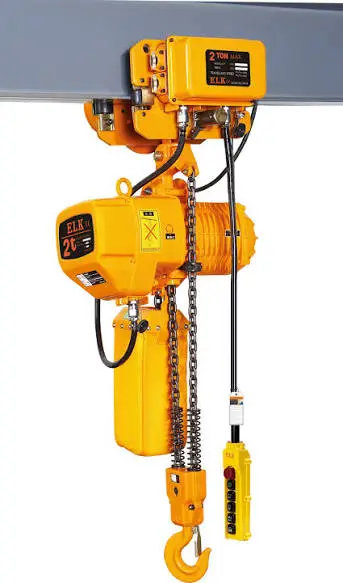
In simple terms, an electric chain hoist is a lightweight, motorized lifting device that uses a heavy-duty metal chain (rather than a wire rope) to raise and lower loads.
Think of it as an electric winch with a built-in gearbox. You simply press a button, and the electric motor powers a series of gears that pull the chain over a specialized wheel (sprocket), effortlessly lifting weights ranging from 125 kg up to 60 tons. Because they use chains instead of ropes, these hoists are incredibly durable, compact, and highly resistant to wear and tear.
2. Where Are They Used?
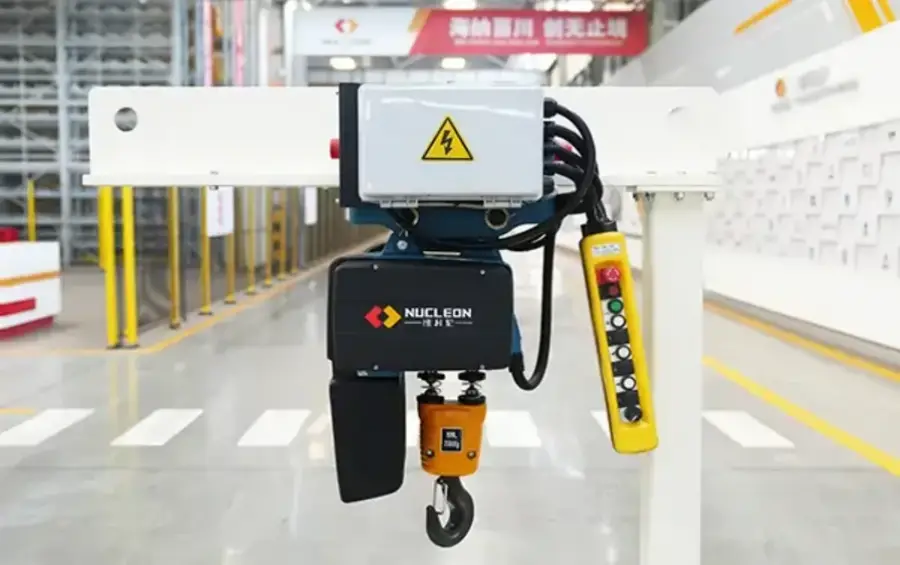
Electric chain hoists are the ultimate workhorses for light-to-medium lifting tasks. They are commonly used in:
●Factories & Workshops: For lifting motors, molds, and assembly parts.
●Warehouses: For loading/unloading trucks and managing inventory.
●Maintenance: Mounted on jib cranes or gantry cranes for repairing heavy equipment.
●Construction Sites: For lifting building materials to higher floors.
3. Professional Deep Dive: Core Components & Engineering
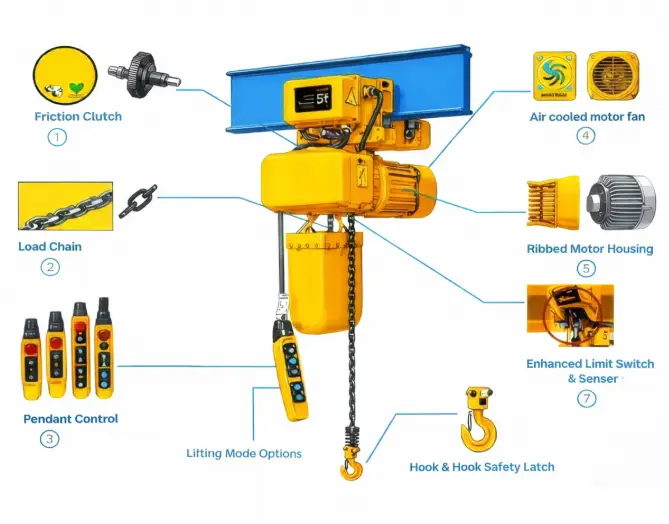
While they may look simple from the outside, electric chain hoists are highly engineered machines designed to operate safely under extreme stress. Understanding their internal anatomy is key to appreciating their reliability:
●High-Strength Alloy Chain: Unlike standard steel, modern hoists use ultra-heat-treated alloy steel chains (such as G80 or FEC80 grade). These chains are designed to withstand massive tensile forces and are highly resistant to stretching or breaking.
●Precision Gearbox & Oil Bath Lubrication: The internal gears are typically forged from high-strength alloy steel and undergo high-temperature quenching to increase wear resistance. They operate inside a sealed gearbox using an oil-bath lubrication system, which ensures smooth, quiet operation and extends the mechanical lifespan.
●Aluminum Alloy Shell: To protect the internal components, the outer casing is usually made of lightweight, high-strength aluminum alloy. This design is not only impact-resistant but also provides excellent heat dissipation, preventing the motor from overheating during continuous use.
●Electromagnetic Braking System: Safety is paramount. These hoists feature a side magnetic braking device that instantly engages the moment power is lost or the stop button is pressed. This guarantees that the load will never accidentally slip or drop.
4. Advanced Safety Features & Smart Technology
Modern electric chain hoists go beyond basic lifting; they are equipped with intelligent safety redundancies to protect both the operator and the equipment:
●Dual Limit Switches: To prevent the dangerous "chain over-winding" scenario, hoists are equipped with both electronic and mechanical limit switches. When the hook reaches its upper or lower limit, the electronic switch cuts power, and the mechanical switch acts as a physical backup to lock the system.
●Overload Protection: Many models feature a powder metallurgy clutch or an electronic overload limiter. If the operator tries to lift a load exceeding the rated capacity, the clutch will slip or the system will shut down, preventing catastrophic gear failure.
●Inverse Phase Sequence Protection: This special electrical device prevents the motor from running in reverse if the power supply is wired incorrectly, avoiding dangerous operational errors.
●Smart & Variable Speed Options: Advanced hoists now offer dual-speed or variable frequency drive (VFD) capabilities. This allows operators to use a fast speed for general lifting and a micro-speed (e.g., 1/10th of normal speed) for precision placement, making them ideal for delicate assembly tasks.
Frequently Asked Questions
Q1: How does an electric chain hoist differ from a wire rope hoist?
A: Chain hoists are more compact, have a smaller vertical lifting height, and are better suited for low-headroom spaces. Wire rope hoists, on the other hand, are better for very heavy loads (over 10 tons) and require much higher lifting heights.
Q2: Can I use an electric chain hoist outdoors?
A: Yes, but you must select a model with the appropriate Ingress Protection rating (e.g., IP54 or IP55) to protect against dust and water. You should also ensure the chain and hooks are properly galvanized or coated to prevent rust.
Q3: What is the maximum duty cycle for these hoists?
A: Standard electric chain hoists typically have a working class of M3 or M4, meaning they are designed for intermittent use. For continuous, heavy-duty operations, you must ensure the hoist has an adequate duty cycle (e.g., 50% ED) and avoid exceeding the maximum hourly switching limit (usually 120 times per hour).
Contact Us
●Custom Load Analysis: We’ll evaluate your lifting requirements to recommend the exact capacity, lifting height, and speed configuration.
●Tailored Solutions: From wireless remote controls to explosion-proof configurations, we customize hoists to your exact workflow.
●Comprehensive Support: Enjoy peace of mind with our expert installation guidance, operator training, and global spare parts supply.