
 English
 Español
 Русский
 العربية
 Français
 Deutsch
 Português
 Tiếng Việt
 ไทย
 Bahasa Indonesia
 Türkçe
 Italiano





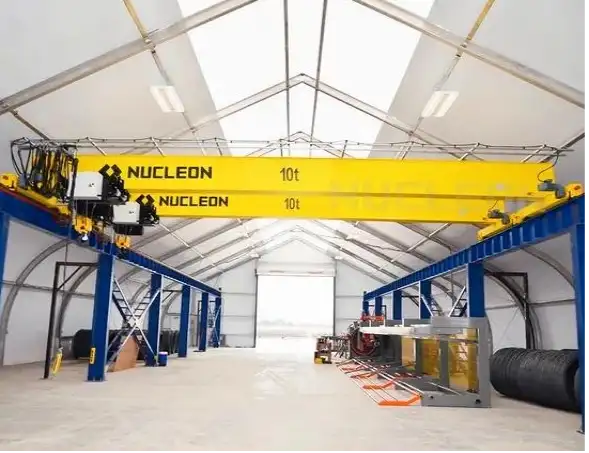
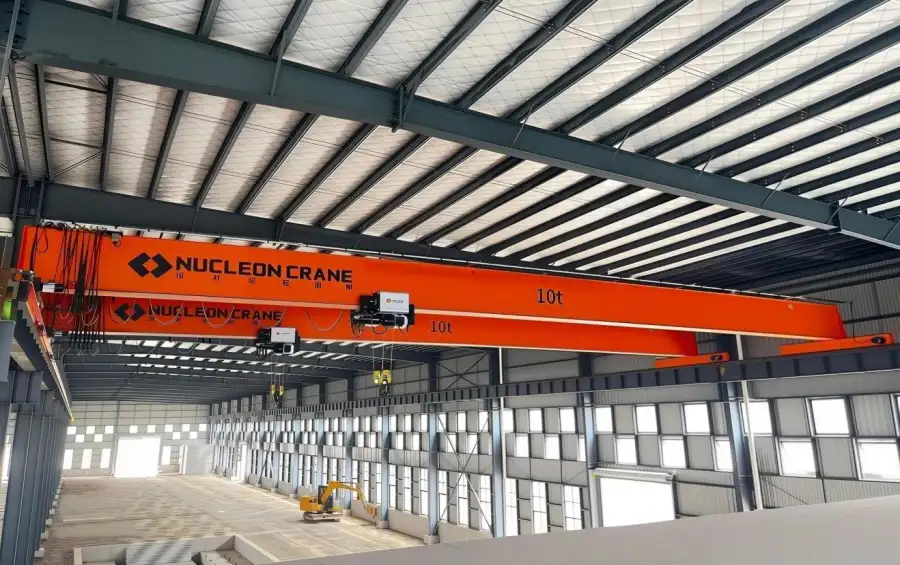
The Nucleon European Single Girder Bridge Crane is engineered to meet the rigorous demands of modern industrial facilities. Unlike traditional overhead cranes, this system integrates European design principles to maximize lifting precision while minimizing structural footprint. It is specifically developed for operations requiring high accuracy, reduced wheel loads, and energy-efficient performance.
This crane serves as a direct upgrade path for facilities currently operating standard American-style cranes. By combining a compact box-girder main beam with advanced variable frequency drive (VFD) controls, the Nucleon crane delivers superior operational smoothness and safety. It is designed to integrate seamlessly into existing infrastructure without requiring costly building modifications.
Box-Girder Main Beam
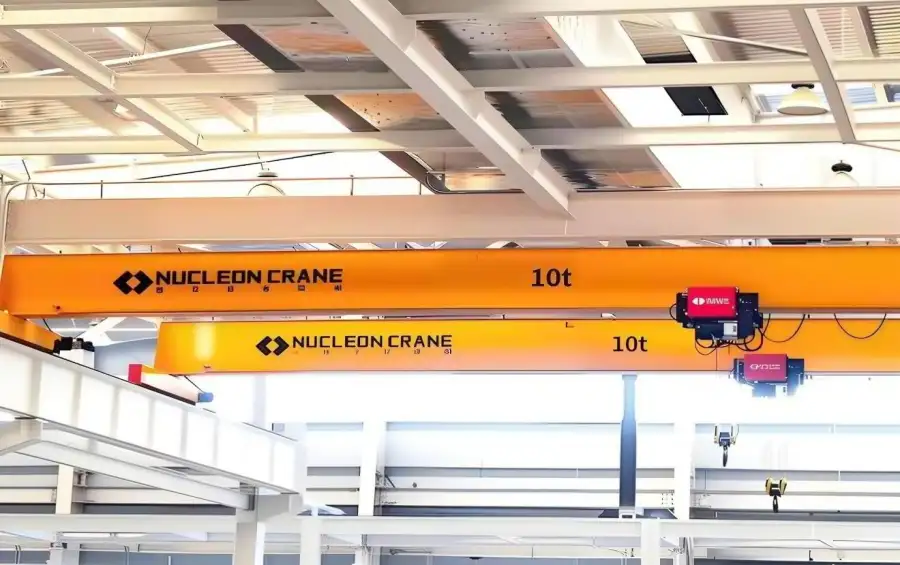
The main beam is the structural backbone of the Nucleon crane, designed to optimize the strength-to-weight ratio. Unlike standard I-beams that rely on the entire cross-section for bending resistance, the box girder utilizes a welded steel plate construction. This allows engineers to place material exactly where stress loads are highest, resulting in a lighter beam that maintains superior rigidity.
Key structural design points include:
•Welded Steel Construction: The beam is fabricated from high-strength steel plates, welded using automated submerged arc processes to ensure consistent penetration and structural integrity.
•Optimized Stiffness: The box shape provides high torsional rigidity, preventing lateral twisting during heavy lifts. This is critical for maintaining alignment with the runway rails and ensuring smooth trolley travel.
•Reduced Dead Weight: By eliminating unnecessary steel mass found in standard I-beams, the box girder reduces the crane’s dead weight. This directly contributes to the 20-40% reduction in wheel pressure, allowing the crane to operate on lighter runway beams and building columns.
•Precision Machining: The trolley rail is machined directly onto the top flange of the box girder. This ensures a perfectly flat running surface, reducing wear on trolley wheels and minimizing maintenance intervals.
The compact profile of the box girder also improves hook coverage. The hoist can be positioned closer to the end trucks, maximizing the usable lifting area within the building’s width.
VFD Control & Anti-Sway Technology
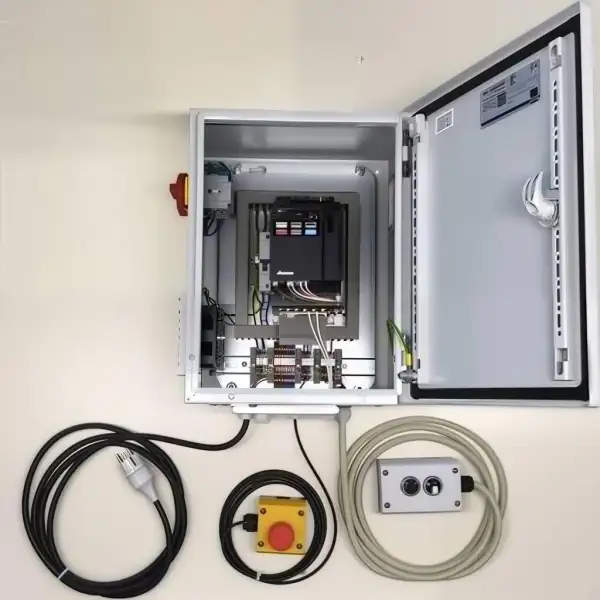
Operational precision is defined by the control system. The Nucleon crane comes standard with VFD control for both hoisting and traveling motions, replacing the binary on/off logic of traditional AC contactors. This technology provides stepless speed control, allowing operators to inch loads with millimeter accuracy.
Benefits of VFD Control
•Smooth Acceleration/Deceleration: VFDs ramp motor speed up and down gradually. This eliminates the “shock loading” that occurs when standard cranes start or stop abruptly, protecting the gearbox, brakes, and structural welds.
•Energy Efficiency: VFDs match motor output to the actual load requirement. During light lifts or partial speeds, energy consumption drops significantly. Additionally, regenerative braking can feed energy back into the system during deceleration.
•Extended Component Life: Reduced mechanical shock means less wear on wire ropes, drum bearings, and runway rails. Maintenance costs are lowered as components last longer between replacements.
Integrated Anti-Sway Technology
Load sway is a natural consequence of crane acceleration, but the Nucleon system manages it through intelligent VFD algorithms. The anti-sway function is built directly into the drive logic, requiring no external sensors or complex rigging.
The system works by calculating the pendulum period of the suspended load based on rope length and acceleration rates. When the operator commands a stop, the VFD executes a precise deceleration profile that counteracts the swing momentum. This results in the load settling almost immediately upon stopping, rather than oscillating for several seconds.
For operators, this means faster cycle times and enhanced safety. Loads can be placed accurately without waiting for sway to dampen naturally, reducing the risk of collision with surrounding equipment or personnel. The system adapts automatically to varying hook heights, maintaining consistent performance throughout the lift.
Configuration & Specifications
The Nucleon European Single Girder Bridge Crane is available in a wide range of configurations to suit diverse industrial applications. All units are manufactured to strict FEM standards, ensuring reliability and safety.
Control Flexibility: Operators can choose from a standard push-button pendant for general use, a radio remote for improved visibility and safety, or an enclosed cabin for high-duty cycle applications. All control interfaces are compatible with the VFD system.
Electrical Standards: The crane is configured for standard industrial power supplies (380V-480V, 3-Phase). Insulation is F-Class as standard, with H-Class insulation available for environments with elevated ambient temperatures or high thermal cycling.
Duty Ratings: Available in FEM 2m to 3m classifications (A3-A6), covering everything from occasional maintenance lifts to intensive production handling.
Maintenance Advantages
The VFD control system significantly reduces mechanical stress on the crane. Without the repetitive shock loading of AC contactors, structural fatigue is minimized.
Key maintenance benefits include:
•Brake Longevity: Smooth deceleration reduces brake wear, extending service intervals.
•Gearbox Health: Stepless speed control prevents gear tooth pitting caused by sudden torque spikes.
•Modular Replacement: Critical components are designed for quick swap-out, reducing repair time.
Typical Applications
The Nucleon crane is ideal for facilities where precision and space efficiency are paramount:
•Automotive Assembly: Precise component placement and engine handling.
•Paper & Printing: Delicate roll handling requiring smooth acceleration.
•Aerospace: Sensitive component assembly with strict safety tolerances.
•Warehousing: High-density storage with low headroom constraints.
•Machine Shops: CNC machine loading and maintenance support.
Frequently Asked Questions
1.What is the maximum lifting capacity of the Nucleon European Single Girder Crane?
The standard range covers 0.5t to 20t. For capacities above 20t, a double girder configuration is typically recommended, but single girder options up to 20t are fully supported with box-girder engineering.
2. How does the anti-sway system work without external sensors?
The anti-sway function is integrated into the VFD software. It uses mathematical modeling of the load pendulum based on rope length and acceleration to adjust motor output in real-time, eliminating sway without requiring laser or camera sensors.
3. Can this crane be installed on existing American-style runway beams?
Yes. Because the European design reduces wheel pressure by 20-40%, it often places less stress on existing runway beams than the original crane. However, a structural engineer should always verify runway capacity before installation.
4. What is the typical installation time?
For a standard single girder crane within the 3m-30m span range, installation typically takes 1-3 days. This assumes the runway system is already in place and power supply is accessible.
5. Is the VFD control system difficult to maintain?
No. Modern VFDs are solid-state devices with no moving parts. They require minimal maintenance compared to AC contactors, which have mechanical contacts that wear out and require regular replacement. Diagnostic LEDs on the drive simplify troubleshooting.