

 English
 Español
 Русский
 العربية
 Français
 Deutsch
 Português
 Tiếng Việt
 ไทย
 Bahasa Indonesia
 Türkçe
 Italiano





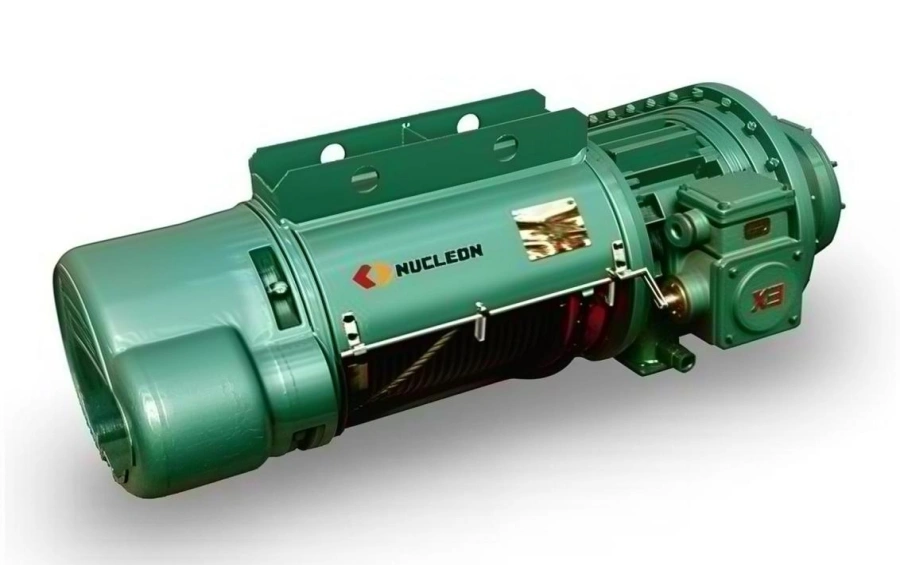
The Nucleon explosion-proof electric hoist is designed for lifting operations in atmospheres where flammable gases, vapors, or combustible dusts create ignition risks. Certified to ATEX, IECEx, and TR CU standards, this equipment is rated for Zone 1 and Zone 2 gas environments (Exd IIB T4 and Exd IIC T4) and Zone 21 and Zone 22 dust environments (ExtD A21 IP65 T130°C), serving chemical plants, oil refineries, pharmaceutical facilities, LNG terminals, paint shops, and grain handling operations where standard hoists cannot safely operate.
Unlike standard electric hoists where electrical arcing, mechanical sparks, or surface overheating can ignite hazardous atmospheres, Nucleon explosion-proof hoists incorporate flameproof enclosures, spark-resistant materials, and temperature-limited surface designs to prevent ignition sources from contacting the surrounding atmosphere.
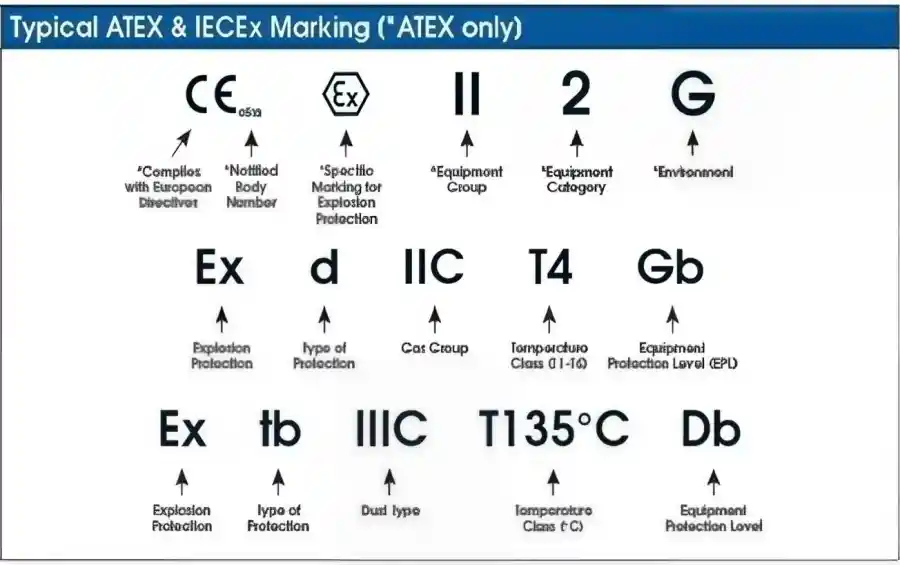
Explosion-Proof Certification: Reading the Markings Correctly
Procurement decisions for explosion-proof equipment depend on correct certification matching. Nucleon explosion-proof hoists carry the following certification markings:
•Gas Environment (Exd IIB T4 / Exd IIC T4): “Exd” indicates flameproof enclosure protection—the housing contains any internal explosion and prevents flame propagation to the surrounding atmosphere. “IIB” covers gases such as ethylene, propane, and gasoline; “IIC” is the highest gas group covering hydrogen, acetylene, and water gas. “T4” limits maximum surface temperature to 135°C.
•Dust Environment (ExtD A21 IP65 T130°C): “ExtD” covers combustible dust protection. “A21” applies to Zone 21 dust environments where combustible dust clouds may occur during normal operation. IP65 ensures dust-tight enclosure with water jet protection. T130°C limits surface temperature to prevent dust ignition.
•International Standards: Compliance with ATEX (EU Directive 2014/34/EU), IECEx (international certification scheme), and TR CU (Eurasian Conformity) enables deployment across European, Middle Eastern, Asian, and CIS markets.
Specifying an incorrect rating—such as IIB when IIC is required, or omitting dust certification in a Zone 21 environment—creates safety non-compliance and potential regulatory violations.
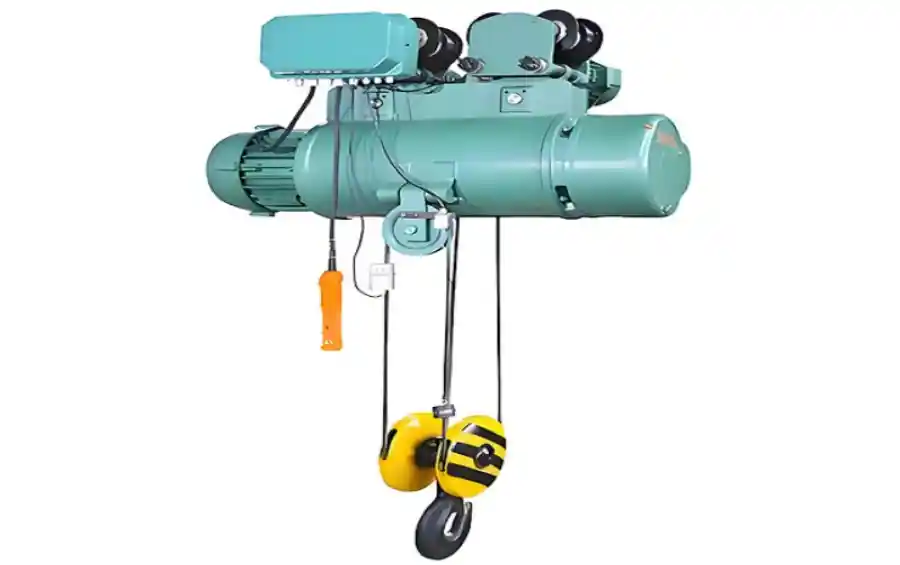
Nucleon offers two primary explosion-proof hoist series:
BNR Standard Explosion-Proof Hoist (New Chinese Series) Built on Nucleon’s “New Chinese” electric hoist platform with a space-frame support structure and classic “C”-type hoisting arrangement:
•Capacity Range: 0.25 to 30 tons
•Work Duty: M5 classification
•Drive System: Coaxial three-in-one drive unit simultaneously powers both wheel sets
•Hook Approach: Optimized “C”-type layout minimizes the distance between hook and runway beam
•Operating Temperature: -20°C to +40°C standard range
BNR-LC Low Headroom Explosion-Proof Hoist Engineered for installations where vertical clearance is constrained:
•Compact Design: Reduced overall height allows installation in facilities with limited building height
•Large-Diameter Drum: Maintains adequate rope capacity despite the compact envelope, supporting lift heights from 6 to 30 meters
•Same Explosion-Proof Rating: Retains Exd IIC T4 and ExtD A21 IP65 certifications identical to the standard BNR series
Both series can be mounted on single-girder overhead cranes, double-girder overhead cranes, gantry cranes, and jib cranes.
Core Safety Design Features
Flameproof Motor and Electrical Enclosure The hoisting motor is a flameproof three-phase asynchronous motor with an electromagnetic brake. The motor housing contains any internal explosion, and the gap between mating surfaces cools escaping gases below the ignition temperature. The motor features F-class insulation and IP65 protection.
Spark-Resistant Mechanical Components All components that could generate mechanical sparks are manufactured from spark-resistant materials:
-Hook Assembly: High-strength alloy steel hooks with safety latches, optionally available with copper-plated or bronze-plated surfaces for IIC environments
-Wire Rope Guide and Drum: Designed to prevent rope derailment and eliminate metal-to-metal contact
-Trolley Wheels: Manufactured from materials that minimize spark generation during travel
Temperature Monitoring and Overheat Protection The motor is equipped with embedded thermistors for overheat protection. If the motor temperature approaches the T4 limit (135°C), the control system triggers an alarm and can shut down operation.
Electro-Mechanical Overload Protection An electro-mechanical overload protector prevents operation when loads exceed rated capacity, critical in explosion-proof environments where overload-induced motor stalling could cause rapid temperature rise.
Dual-Step Limit Switches Two-stage hoisting limit switches provide redundant protection against over-travel. The first stage slows the hoist as it approaches the upper limit; the second stage cuts power if the first stage fails.
Industry Applications
•Chemical & Petrochemical Plants: Handling reactors, heat exchangers, and piping assemblies in areas where solvent vapors or process gases create explosion risks. IIC-rated hoists are required for hydrogen-containing environments such as hydrocracking units.
•Oil Refineries & Gas Processing: Lifting valves, pumps, and maintenance equipment in crude distillation, catalytic cracking, and gas separation areas.
•Pharmaceutical Manufacturing: Solvent handling areas where alcohol, acetone, or other flammable cleaning agents create Zone 1 or Zone 2 conditions.
•LNG Terminals: Loading and maintenance operations where methane may be present.
•Paint Shops & Coating Lines: Areas where solvent-based paint vapors create explosive atmospheres during spraying and drying.
•Grain & Food Processing: Facilities handling flour, sugar, or starch where combustible dust creates Zone 21 or Zone 22 environments. Dust-certified (ExtD) hoists are required.
•Shipbuilding & Offshore: Tank cleaning and repair operations in confined spaces where residual hydrocarbon vapors may persist.
Procurement Specification Checklist
To ensure accurate quotation and regulatory compliance, buyers should provide:
•Hazardous Zone Classification: Zone 1 or Zone 2 for gas; Zone 21 or Zone 22 for dust.
•Gas Group or Dust Type: Specify the specific hazardous substance present (e.g., hydrogen, benzene, flour dust).
•Lifting Capacity: Required capacity in tons, including any below-the-hook lifting devices. Standard range: 0.25 to 30 tons.
•Lift Height: Required hook travel distance. Standard range: 6 to 30 meters.
•Work Duty: Expected operating hours per year and load factor. M5 duty class is standard.
•Voltage and Frequency: Available power supply (e.g., 380V/50Hz/3-phase, 415V/50Hz, 460V/60Hz).
•Control Method: Pendant push-button control (with explosion-proof pendant station), radio remote control (with ATEX-certified transmitter),
or cabin control.
•Mounting Configuration: Fixed installation, trolley-mounted on single-girder crane, trolley-mounted on double-girder crane, or gantry crane
integration.
•Environmental Conditions: Operating temperature range (-20°C to +40°C standard), humidity levels, presence of corrosive chemicals, and outdoor or indoor installation.
•Certification Requirements: Required certification marks (ATEX, IECEx, TR CU, or GB3836 Chinese national standard).
Frequently Asked Questions
Q: What is the difference between Exd IIB T4 and Exd IIC T4 ratings?
A: Exd IIB T4 covers gases such as propane, ethylene, gasoline, and benzene, with a maximum surface temperature of 135°C. Exd IIC T4 is the highest gas group rating, covering hydrogen, acetylene, and water gas, plus all gases covered by IIB. If your environment contains hydrogen or acetylene, IIC certification is mandatory. IIC-rated hoists can be used in IIB environments but not vice versa.
Q: Can Nucleon explosion-proof hoists be used in Zone 0 environments?
A: No. Nucleon explosion-proof hoists are rated for Zone 1 and Zone 2 gas environments and Zone 21/22 dust environments. Zone 0 environments require specialized equipment with higher protection levels (such as Ex ia intrinsic safety).
Q: What certifications do Nucleon explosion-proof hoists carry?
A: Nucleon explosion-proof hoists are certified to ATEX (EU Directive 2014/34/EU), IECEx (international certification scheme), and TR CU (Eurasian Conformity) standards. They also comply with Chinese national standards GB3836.1 and GB3836.2, as well as JB/T 10222 for explosion-proof electric hoists.
Q: What is the maximum lifting capacity and lift height?
A: Nucleon explosion-proof hoists are available with capacities from 0.25 to 30 tons and standard lift heights from 6 to 30 meters. Custom capacities and lift heights are available based on project requirements.
Q: Can these hoists be installed on existing cranes?
A: Yes. Nucleon explosion-proof hoists can be mounted on single-girder overhead cranes, double-girder overhead cranes, gantry cranes, and jib cranes. For retrofit installations, verify that the runway beam is compatible with the trolley wheel configuration and that the existing electrical supply meets the hoist’s voltage and frequency requirements.