

 English
 Español
 Русский
 العربية
 Français
 Deutsch
 Português
 Tiếng Việt
 ไทย
 Bahasa Indonesia
 Türkçe
 Italiano





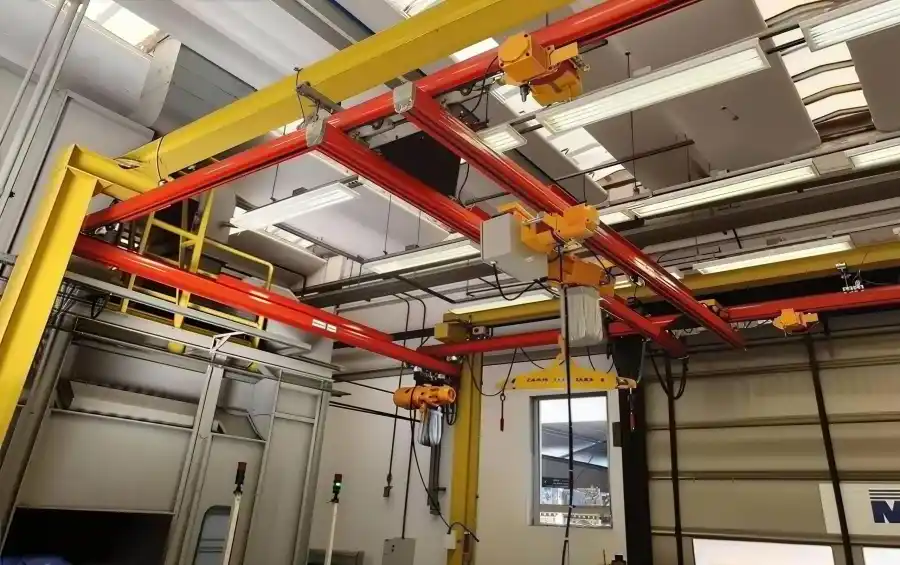
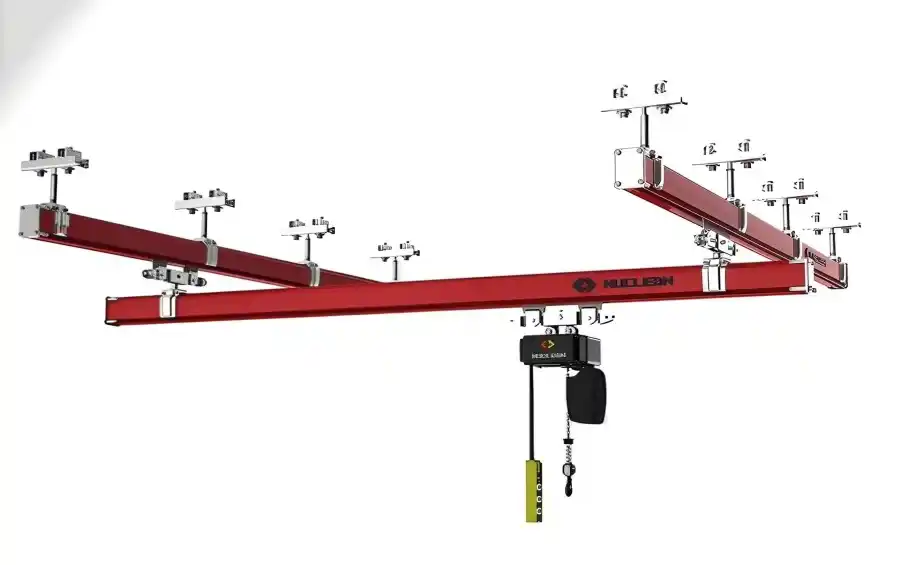
A Nucleon workstation bridge crane is a light-duty, modular overhead handling system built on a KBK (Kombiniert Kran) track framework rather than traditional heavy steel I-beam runway construction. The system uses cold-formed, closed-section steel tracks (C-type profile) with integrated rolling trolleys, enabling smooth, low-effort manual operation and precise load positioning at the workstation level.
Unlike conventional bridge cranes designed for heavy industrial lifting, workstation cranes are engineered for repetitive, precision handling tasks where operator ergonomics, positioning accuracy, and flexible layout are the primary concerns. The KBK track system is the defining feature: the track itself serves as both the structural runway and the rolling surface, eliminating the need for separate trolley wheels and reducing friction significantly.
Nucleon workstation bridge cranes are available in single girder and double girder configurations, with capacities typically ranging from 125 kg to 3,200 kg per girder, depending on span and track specification.
Workstation Bridge Crane vs. Standard Bridge Crane: A Structural Comparison
The distinction is not just capacity—it is fundamental design philosophy.
Standard bridge crane:
-Built on heavy I-beam or box-girder runways
-Designed for high-capacity, high-duty-cycle industrial lifting
-Requires substantial building structure or dedicated support columns
-Higher wheel loads demand robust foundation and runway beam design
-Manual operation requires significant push/pull force
Workstation bridge crane (KBK system):
-Built on cold-formed C-track with integrated rolling trolleys
-Designed for light-duty, repetitive, precision handling at workstation level
-Can be ceiling-mounted (suspended from building roof structure) or floor-supported (freestanding columns)
-Minimal wheel loads allow installation on existing building structures without reinforcement
-Manual operation requires very low push/pull force—typically 1/10 of equivalent I-beam systems
-Modular design allows easy reconfiguration, extension, or relocation
The workstation crane is not a "small bridge crane." It is a fundamentally different system optimized for a different set of operational requirements.
KBK Track System: Core Technology and Structural Advantages
The KBK track is the foundation of the workstation bridge crane. Nucleon workstation cranes use cold-formed, closed-section C-track made from high-quality steel, with the following characteristics:
Track profile:
-C-type closed-section profile with integrated rolling surface
-Track sizes typically include C-track I (for lighter loads) and C-track II (for heavier loads)
-The closed section provides high torsional rigidity and resists twisting under off-center loads
-The integrated rolling surface eliminates the need for separate trolley rails
Rolling trolley design:
-Trolleys run directly on the track's integrated rolling surface
-Precision bearings minimize rolling resistance
-Trolleys are self-centering, preventing derailment even under side-loading conditions
-Trolley spacing can be adjusted to match hoist dimensions and load requirements
Connection method:
-Track sections are connected using bolted splice plates or hanger connections
-No welding required for track assembly—enabling fast installation and future modification
-Hanger rods (for suspended systems) or support columns (for freestanding systems) are spaced at intervals determined by load and span calculations
Advantages over I-beam systems:
-Lower friction: Rolling resistance is approximately 1/10 of equivalent I-beam systems, enabling effortless manual operation
-Higher positioning accuracy: Low-friction trolleys allow precise load placement, critical for assembly and machining operations
-Modular flexibility: Track sections can be added, removed, or reconfigured without major structural modification
-Reduced building load: Lighter track system imposes lower loads on building structure compared to I-beam runways
Single Girder vs. Double Girder: Configuration Selection Logic
Nucleon workstation bridge cranes are available in two primary configurations:
Single girder workstation bridge crane:
-One main girder spanning between the end trucks
-Hoist runs on a trolley along the single girder
-Simpler structure, lower cost, faster installation
-Suitable for capacities up to approximately 1,000–2,000 kg depending on span and track specification
-Recommended for most workstation applications where headroom is not severely constrained
Double girder workstation bridge crane:
-Two parallel girders spanning between the end trucks
-Hoist runs on a trolley between the girders
-Higher hook height for the same overall crane height (hoist sits between girders rather than below)
-Better torsional rigidity for precision lifting
-Suitable for heavier capacities or applications requiring greater hook height within limited building clearance
-Recommended for applications where vertical space is constrained or higher capacity is required
Selection logic:
-Choose single girder for standard workstation applications with moderate capacity requirements and adequate headroom.
-Choose double girder for applications requiring higher hook height, heavier capacity, or improved torsional stability.
Suspended vs. Freestanding Installation: Structural Implications
Workstation bridge cranes can be installed in two ways:
Suspended (ceiling-mounted) system:
-Track is suspended from the building roof structure using hanger rods
-No floor columns required—maximizes floor space utilization
-Requires adequate building roof structure to support crane loads
-Lower installation cost (no foundation or columns required)
-Best for existing facilities with suitable roof structure
Freestanding (floor-supported) system:
-Track is supported by dedicated floor columns anchored to the foundation
-Does not depend on building structure—can be installed in any facility
-Requires floor foundation for column anchoring
-Slightly higher installation cost but independent of building constraints
-Best for facilities without suitable roof structure or where the crane needs to be relocated
Selection logic:
-Choose suspended if the building roof structure can support the crane loads and floor space optimization is a priority.
-Choose freestanding if the building structure cannot support the loads or if the crane may need to be relocated in the future.
Hoist Integration: Chain Hoist vs. Wire Rope Hoist
The workstation bridge crane is a track system—the lifting mechanism (hoist) is specified separately based on application requirements. Nucleon workstation cranes typically integrate NL series chain electric hoists as the standard lifting mechanism.
Chain hoist (manual or electric):
-Compact size fits within the limited headroom of workstation cranes
-Manual chain hoists are common for very light-duty, infrequent operations
-Electric chain hoists (such as Nucleon NL series) are the standard choice for repetitive workstation lifting
-Lower maintenance requirements compared to wire rope hoists
-Recommended for most workstation applications
-Suitable for higher capacities within the workstation crane range
-Faster lifting speeds compared to chain hoists
-Requires more headroom due to drum and rope storage requirements
-Recommended for applications where lifting speed is a priority or capacity exceeds chain hoist range
Hoist selection considerations:
-Lifting capacity: Must match or exceed the crane's rated capacity
-Lifting height: Must accommodate the required hook travel within the available headroom
-Power supply: Must match available voltage and frequency (e.g., 380V/50Hz, 415V/50Hz, 460V/60Hz)
-Control method: Pendant push-button control is standard; radio remote control is optional
-Duty cycle: Must match expected operating intensity
Installation and Commissioning Notes
Structural verification (suspended systems): Before installation, verify that the building roof structure can support the crane loads. A structural engineer should review hanger rod loads and roof beam capacity.
Foundation (freestanding systems): Column foundations must be completed and cured before crane installation. Foundation drawings are provided with the crane specification.
Track assembly: Track sections are bolted together using splice plates. Track alignment must be checked for straightness and levelness. Trolleys should roll smoothly along the entire track length without binding.
Hanger/column installation: Hanger rods (suspended) or support columns (freestanding) must be installed at specified intervals. Vertical alignment is critical for smooth trolley operation.
End truck installation: End trucks are mounted at each end of the girder. Wheel alignment must be checked to ensure the crane travels smoothly along the runway track.
Hoist installation: Hoist (such as Nucleon NL series chain hoist) is mounted on the trolley and connected to power supply. All electrical connections must comply with local electrical codes.
Commissioning tests: Verify trolley rolling resistance, hoist braking performance, limit switch functionality, and emergency stop operation. Manual operation should require minimal push/pull force.