

 English
 Español
 Русский
 العربية
 Français
 Deutsch
 Português
 Tiếng Việt
 ไทย
ไทย
 Bahasa Indonesia
 Türkçe
 Italiano





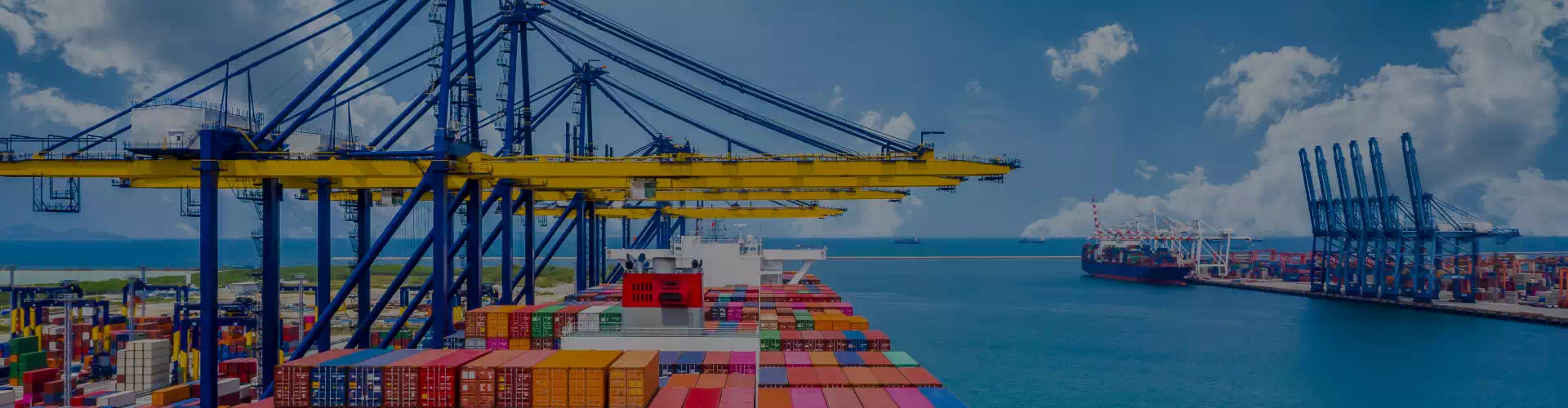
In the industrial lifting sector, when a standard gantry crane is impossible to install due to space constraints, and a jib crane cannot cover enough area, the Single Girder Semi Gantry Crane often emerges as the most cost-effective solution. This article provides an in-depth look at the core concepts, application scenarios, unique advantages, and crucial technical parameters for selecting this equipment.
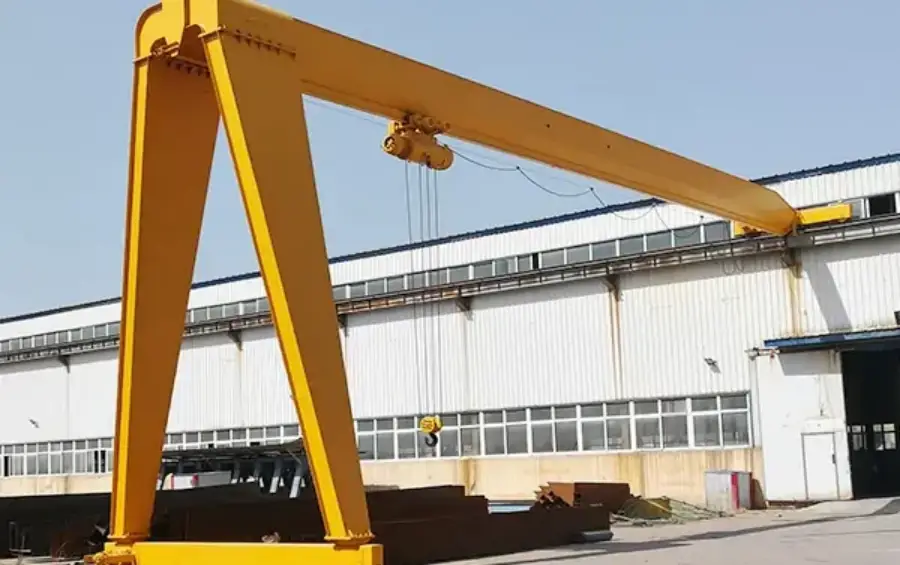
What is a Single Girder Semi Gantry Crane?
A Single Girder Semi Gantry Crane is a lightweight lifting device with an asymmetrical structure. Its defining features include:
▪Single-Side Support: One end of the bridge is supported by a leg that travels on a ground-level rail.
▪Wall/Bench Attachment: The other end of the bridge is supported directly by the building’s wall, columns, or an independent elevated runway, eliminating the need for a second ground leg.
▪Single Girder Design: Typically utilizing an I-beam or box-type girder paired with an electric hoist, this design ensures a compact profile and lighter deadweight compared to double girder systems.
Essentially, it acts as a hybrid between a “half-gantry” and a “bridge crane,” specifically engineered for workshops where one side has open floor space and the other relies on existing structural support.
When Should You Use It? (Application Scenarios)
This crane isn’t a one-size-fits-all solution, but it is indispensable in specific situations:
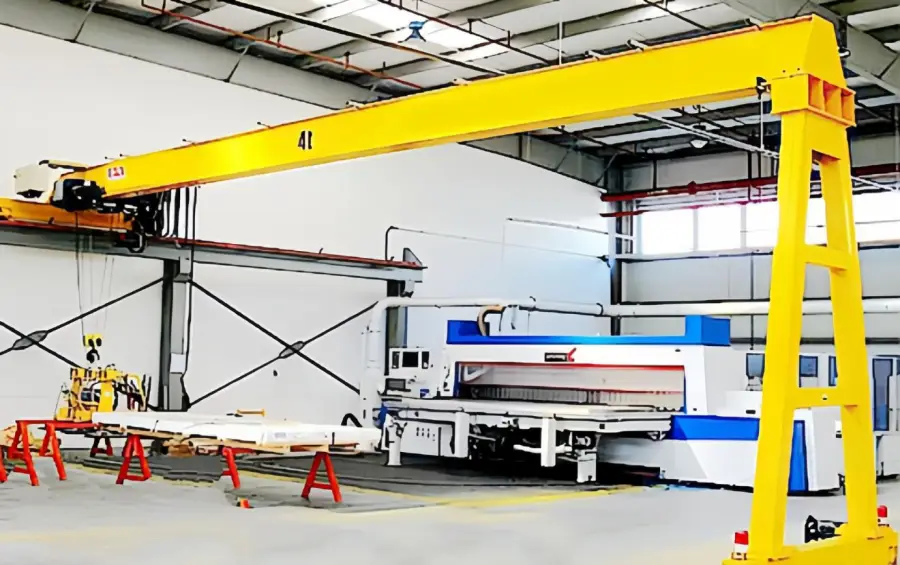
▪Extremely Limited Floor Space: Workshops already packed with machinery or racks where installing a second set of ground rails and legs is impossible.
▪Leveraging Existing Structures: Facilities with robust columns or load-bearing walls on one side that can serve as the high-side runway, significantly cutting construction costs.
▪Moderate Loads & Spans: Ideal for lifting tasks typically ranging from 1 to 10 tons with relatively short spans.
▪Avoiding Ground Obstacles: Areas where the ground has fixed large equipment, pits, or trenches that prevent the laying of dual tracks.
▪Outdoor/Temporary Yards: Such as a storage yard backing onto a warehouse wall, requiring flexible material handling without full infrastructure investment.
Core Advantages
Compared to double girder gantries or standard overhead cranes, the single girder semi-gantry offers distinct benefits:
▪Maximized Space Utilization: By eliminating one set of ground legs and rails, it frees up valuable aisle space for forklifts and personnel.
▪Cost Efficiency: Fewer components (one less leg, wheel set, and ground foundation) translate to lower initial capital expenditure.
▪Easy Installation & Maintenance: The simpler structure means faster assembly and fewer maintenance points, reducing long-term operational costs.
▪Flexibility: Can be configured with manual or electric drives and adapted to various span requirements, making it versatile for different workshop layouts.
Critical Technical Parameters & Their Impact
When selecting a crane, understanding key technical parameters is vital as they dictate performance and safety.
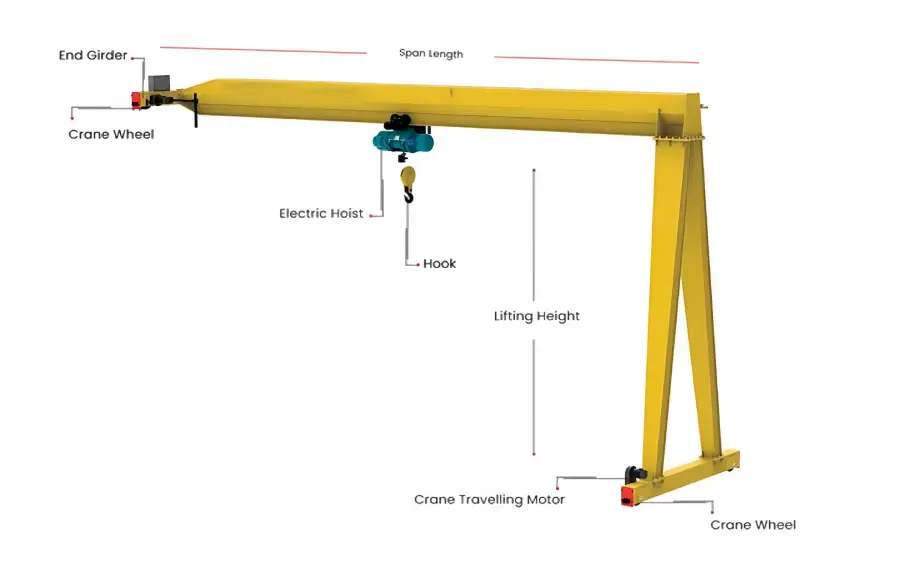
▪Rated Load (Capacity) determines the maximum weight the crane can safely lift, directly influencing the size of the hoist, motor power, and structural thickness of the girder; overloading risks structural failure.
▪Span (S), defined as the horizontal distance between the center of the ground rail and the high-side runway, directly affects the bending moment on the girder, requiring a heavier, stronger beam to prevent deflection as the span increases.
▪Lifting Height (H) dictates the vertical travel distance of the hook, which determines the hoist size and building height, as insufficient height limits the size of movable loads.
▪Working Duty (FEM/ISO Class) reflects how frequently and intensely the crane operates, influencing the choice of motors and gearboxes, where high-duty cycles require robust, heat-resistant components.
▪Finally, matching the Voltage & Phase to the factory’s power grid is essential, as any mismatch requires transformers or custom motor winding to ensure safe operation.
Frequently Asked Questions (FAQ)
Q1: Can I install a semi-gantry crane if my wall isn’t strong enough?
A: Yes. If the existing wall cannot support the load, you can install an independent steel column or a specialized runway bracket system anchored to the floor or foundation to support the high side of the crane.
Q2: What is the maximum capacity for a single girder semi-gantry crane?
A: While custom designs exist, the economical and standard range is typically up to 10 tons. For loads exceeding 16-20 tons, a double girder design is usually recommended for better stability and hook height.
Q3: Does the “semi” structure affect stability compared to a full gantry?
A: The high-side support actually adds significant rigidity. However, because the structure is asymmetrical, the horizontal forces (skewing) during travel must be calculated carefully. Proper wheel alignment and high-quality drive motors are essential to prevent “crabbing” (drifting sideways).
Q4: Can this crane be used outdoors?
A: Absolutely. Many semi-gantry cranes are used in outdoor stockyards. For outdoor use, we recommend adding rain covers for the hoist, using IP65-rated electrical components, and installing rail clamps or anchors to secure the crane against strong winds when not in use.
Contact Us
Choosing the right lifting equipment is about balancing efficiency, safety, and budget. Whether you have a complex layout challenge or need a straightforward material handling upgrade, our engineering team is here to help.