

 English
 Español
 Русский
 العربية
 Français
 Deutsch
 Português
 Tiếng Việt
 ไทย
 Bahasa Indonesia
 Türkçe
 Italiano





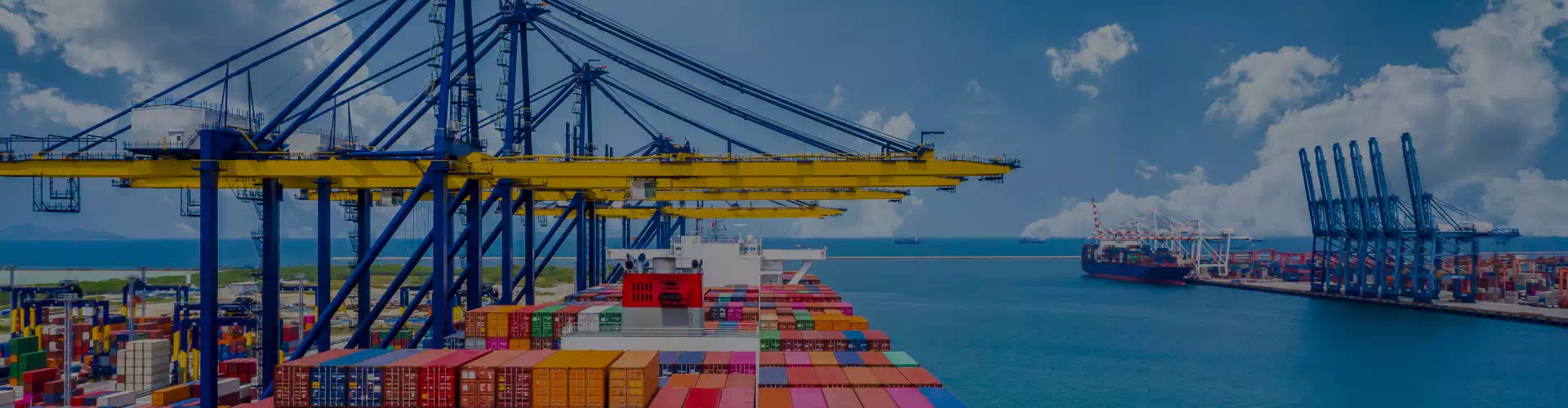
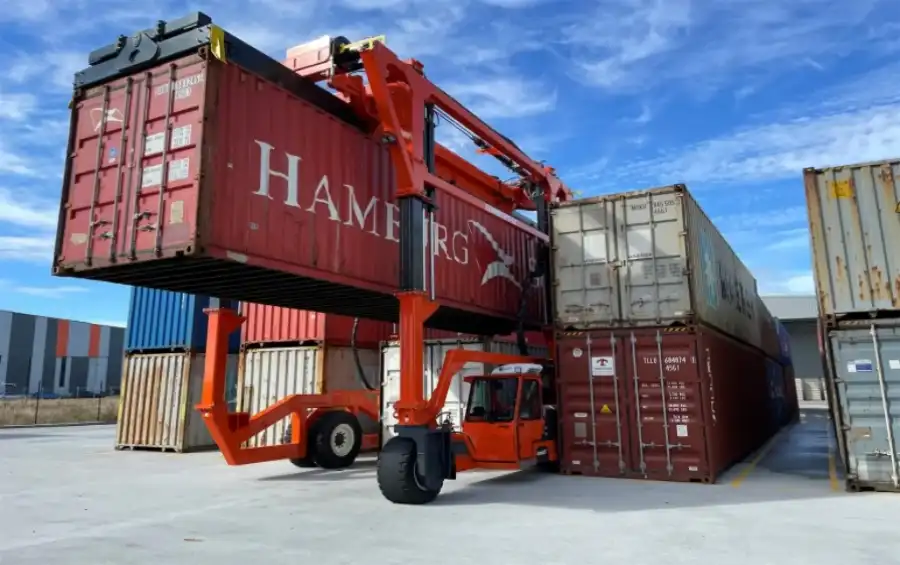
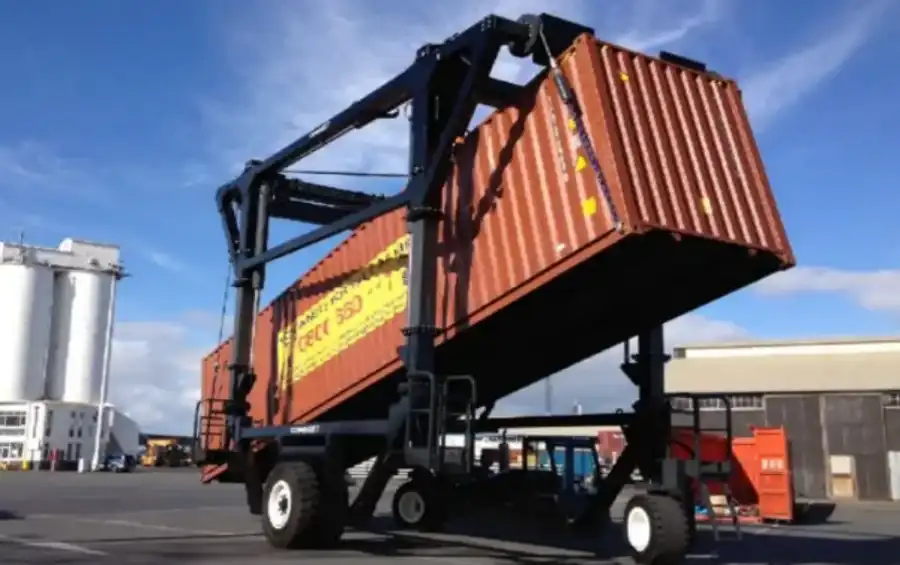
The container straddle carrier crane is a specialized, self-propelled vehicle engineered to integrate horizontal transport and vertical stacking into a single operational cycle. Unlike terminal tractors that require external ground equipment for loading and unloading, or rail-mounted gantry cranes (RMGs) confined to fixed tracks, straddle carriers operate on rubber tires with complete yard mobility.
This equipment serves as the primary interface between quay cranes and automated stacking cranes (ASCs) in modern terminals, or as the standalone handling solution for non-core container facilities. Its engineering is defined by the need to balance structural rigidity, lifting speed, and tire longevity in high-cycle environments.
Structural Configurations and Stacking Logic
The stacking configuration dictates the crane's structural mass, center of gravity, and yard space utilization.
1-over-2 Configuration: The most common design for mid-volume terminals. It stacks three containers high (2+1), offering a balance between speed and storage density. The lower structural height reduces wind load and allows for faster hoist cycles.
1-over-3 and 1-over-4 Configurations: Designed for high-density storage in land-constrained terminals. These units require reinforced portal frames and higher-capacity hoist systems. The increased lifting height necessitates advanced anti-sway control systems to maintain positioning accuracy at maximum elevation.
Twin-Lift Capability: Many modern straddle carriers are rated for twin-20ft lifts (typically 50-ton capacity). This requires a reinforced spreader frame and dual-twistlock mechanisms to handle two 20-foot containers simultaneously, effectively doubling throughput per cycle for empty or light-load repositioning.
Powertrain Architectures and Energy Management
The choice of powertrain directly impacts operational expenditure (OPEX) and infrastructure requirements.
-Diesel-Electric (DE) Drive: The dominant architecture for heavy-duty applications. A diesel engine drives a generator that powers individual wheel hub motors. This eliminates mechanical transmissions and differentials, reducing maintenance points while providing precise torque vectoring for steering.
-Hybrid (Diesel-Battery) Systems: Combines a downsized diesel engine with a lithium-ion battery pack. The battery handles peak power demands during hoisting and acceleration, allowing the diesel engine to operate at optimal efficiency. This configuration typically reduces fuel consumption by 25-30% compared to conventional DE drives.
-Full Electric: Zero-emission models powered by high-capacity battery packs. These require opportunity charging infrastructure (pantograph or plug-in) during shift changes. They eliminate engine maintenance entirely but require careful energy management planning to avoid operational downtime.
Automation and Navigation Integration
For automated terminals, the straddle carrier crane transitions from a driver-operated vehicle to an autonomous logistics node.
-Multi-Sensor Fusion: Automated straddle carriers combine RTK-GPS, LiDAR, and optical cameras for centimeter-level positioning. This enables precise alignment with ASCs and quay cranes without physical guide rails.
-Automatic Container Detection: Vision-based systems identify container twistlocks and corner castings autonomously, enabling unassisted engagement even in low-visibility conditions.
-Fleet Coordination: Terminal Operating System (TOS) integration allows real-time task assignment, dynamic routing, and congestion management across multiple automated straddle carriers.
Procurement and Technical Selection Criteria
When specifying a container straddle carrier crane, procurement teams must evaluate parameters specific to terminal operations:
-Lifting Speed: Hoist speeds of 25 m/min or higher are critical for minimizing quay crane wait times. Variable frequency drives (VFDs) should provide smooth acceleration to prevent load swing.
-Travel Speed: Unloaded travel speeds up to 30 km/h enable rapid repositioning between quay and yard blocks. Loaded speeds typically range from 20-25 km/h depending on payload.
-Steering System: Independent hydraulic steering for all wheels (typically 8 wheels) enables multiple steering modes: coordinated, crab, diagonal, and zero-radius pivot. This is essential for navigating congested yard blocks and tight transfer zones.
-Tire Specifications: Straddle carriers operate on compacted surfaces, not paved roads. Tire selection must account for surface abrasiveness, load distribution, and rolling resistance. Super-single tires are increasingly preferred over dual tires for reduced wear and better fuel efficiency.
Frequently Asked Questions
Q1: What is the primary advantage of a straddle carrier over a reach stacker?
A: Straddle carriers offer superior stacking height (3-5 high vs. 2-3 for reach stackers) and faster cycle times for high-volume operations. They also provide better visibility and stability during transport, as the load is carried between the wheels rather than cantilevered in front.
Q2: Can existing diesel straddle carriers be retrofitted with hybrid or electric powertrains?
A: Retrofitting is technically possible but often cost-prohibitive. The structural modifications required for battery integration and the replacement of the entire drivetrain typically approach the cost of a new unit. Most operators opt for new equipment when transitioning to alternative powertrains.
Q3: What infrastructure is required for container straddle carriers?
A: Unlike RMGs, straddle carriers do not require fixed rails or electrified busbars. They operate on compacted gravel or asphalt surfaces, significantly reducing initial infrastructure investment. However, surface maintenance is critical to prevent premature tire wear and ensure stable stacking.
Q4: How do automated straddle carriers handle safety in mixed-traffic environments?
A: Automated straddle carriers are equipped with multi-layered safety systems: 360-degree LiDAR, obstacle detection cameras, and emergency braking systems. In mixed-traffic zones, geofencing and speed restrictions are enforced, and communication protocols with other vehicles and personnel are mandatory.