

 English
 Español
 Русский
 العربية
 Français
 Deutsch
 Português
 Tiếng Việt
 ไทย
 Bahasa Indonesia
 Türkçe
 Italiano






A low headroom overhead crane is a specialized lifting system engineered to maximize the effective lifting height within a fixed vertical envelope. Unlike standard overhead cranes where the hoist hangs directly beneath the trolley frame, a low headroom configuration shifts the hoist drum and lifting mechanism laterally to the side of the trolley. This design fundamentally alters the crane's geometry, significantly reducing the "C-dimension"—the vertical distance from the top of the hook to the bottom of the runway beam.
For facility engineers and procurement teams, specifying a low headroom overhead crane is typically a strategic decision to either avoid costly building modifications in existing structures or to reduce steel construction costs in new facilities. This guide details the mechanical configurations, structural implications, and selection criteria unique to this specialized lifting equipment.
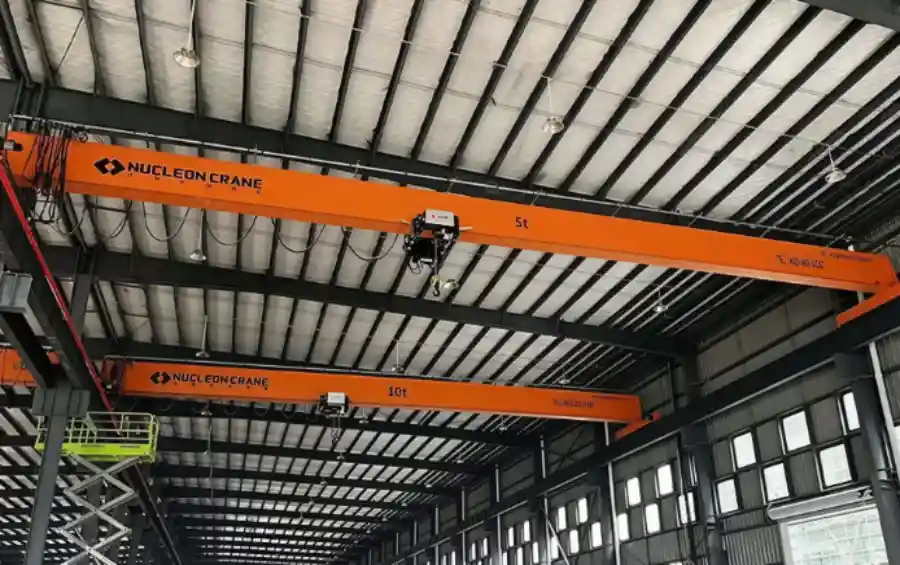
Mechanical Configurations and C-Dimension Optimization
The defining characteristic of a low headroom overhead crane is its hoist placement and trolley geometry. Standard hoists waste vertical space due to the drum sitting directly above the hook. Low headroom designs solve this through specific mechanical arrangements:
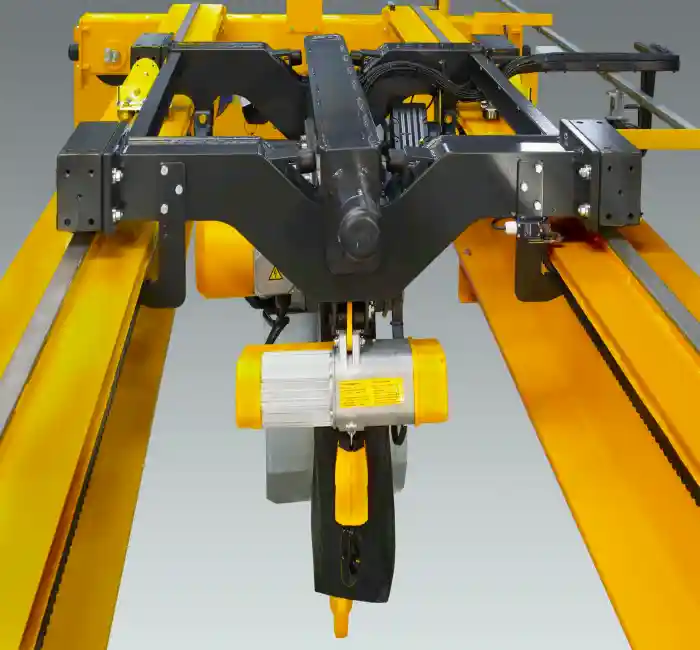
-Side-Mounted Hoist Trolley: The hoist drum and lifting mechanism are positioned laterally beside the trolley frame rather than directly underneath it. This allows the hook to be raised much closer to the runway beam, typically increasing the usable lifting height by 200mm to 500mm compared to standard CD or MD hoists.
-Compact Gearbox and Drum Design: Low headroom hoists utilize high-efficiency, three-stage reduction gearboxes and large-diameter rope drums with optimized rope guides. This reduces the overall dead-weight and vertical profile of the lifting appliance.
-Double Girder Low Headroom: For heavy-duty applications, a low-profile trolley is integrated into a double-girder bridge. This allows for greater lifting heights and capacities (up to 500 tons) while maintaining a compact vertical profile, ideal for heavy industrial operations where ceiling height is restricted.
Structural and Economic Implications
Choosing a low headroom overhead crane provides tangible structural and financial benefits, but it also introduces specific engineering considerations:
-Retrofitting Existing Facilities: In older buildings with low ceilings, a low headroom crane allows operators to achieve the required lifting height without altering the roof structure or raising the building.
-New Construction Cost Savings: For new workshops, maximizing lifting height allows architects to design buildings with lower rooflines. This reduces the required steel tonnage for columns and foundations, potentially lowering total building construction costs by 15-20%.
-Runway Beam Deflection: Because the C-dimension is minimized, the tolerance for runway beam deflection is tighter. Excessive deflection can cause the hoist to bind against the runway beam during travel. The runway structure must be engineered to maintain strict alignment tolerances.
-Hook Approach Dimensions: In highly constrained spaces, the left and right limit dimensions of the hook are critical. Specify the minimum required approach to ensure the crane can service areas directly adjacent to walls or columns.
Technical Selection and Procurement Criteria
When specifying a low headroom overhead crane, procurement teams must evaluate parameters specific to space optimization:
-Capacity and Span: Single girder low headroom cranes are typically suited for light to medium lifting (5 to 25 tons), while double girder configurations handle heavy-duty operations. Spans generally range from 7.5m to 31.5m.
-Working Duty Class: These cranes are available in various duty classes (e.g., A3 for light maintenance, A4/A5 for frequent industrial use). Ensure the duty class matches the operational cycle to prevent premature wear on the compact hoist components.
-Control and Safety: Modern low headroom cranes feature variable frequency drives (VFDs) for stepless speed control, which is essential for precise load positioning in tight spaces. Standard safety features include overload protection, emergency stops, and limit switches.
-Electrical Festooning: In low headroom applications, standard festoon systems may interfere with the hoist. Top-running or enclosed conductor bar systems are often preferred to maintain a compact profile.
Installation Considerations
Installation of a low headroom overhead crane requires precise alignment to ensure the compact hoist operates smoothly without binding.
-Runway Beam Tolerance: Because the C-dimension is minimized, the tolerance for runway beam deflection and alignment is tighter. Excessive deflection can cause the hoist to bind against the runway beam during travel. The runway structure must be engineered to maintain strict alignment tolerances.
-Electrical Festooning: In low headroom applications, standard festoon systems may interfere with the hoist. Top-running or enclosed conductor bar systems are often preferred to maintain a compact profile.
Frequently Asked Questions
Q1: How much lifting height can I gain by switching to a low headroom overhead crane?
A: Depending on the capacity and configuration, a low headroom crane can increase the effective lifting height by 200mm to 500mm compared to a standard hoist of the same capacity. This is achieved by reducing the C-dimension without compromising the building structure.
Q2: Are low headroom cranes suitable for heavy-duty industrial applications?
A: Yes. While single girder low headroom cranes handle up to 25 tons, double girder low headroom configurations are available for capacities ranging from 10 to 500 tons. These utilize a low-profile trolley to maintain a compact design while handling heavy-duty operations.
Q3: Can a low headroom overhead crane be installed in an existing building with a low ceiling?
A: Absolutely. Retrofitting is one of the primary applications for low headroom cranes. They are specifically designed to fit into existing buildings with height restrictions, eliminating the need for costly structural modifications or roof elevations.
Q4: What is the difference between a standard hoist and a low headroom hoist?
A: A standard hoist mounts the drum directly above the hook, maximizing the vertical space required. A low headroom hoist uses an offset trolley design where the drum is positioned to the side, allowing the hook to travel higher and utilizing the available space more efficiently.