

 English
 Español
 Русский
 العربية
 Français
 Deutsch
 Português
 Tiếng Việt
 ไทย
 Bahasa Indonesia
 Türkçe
 Italiano






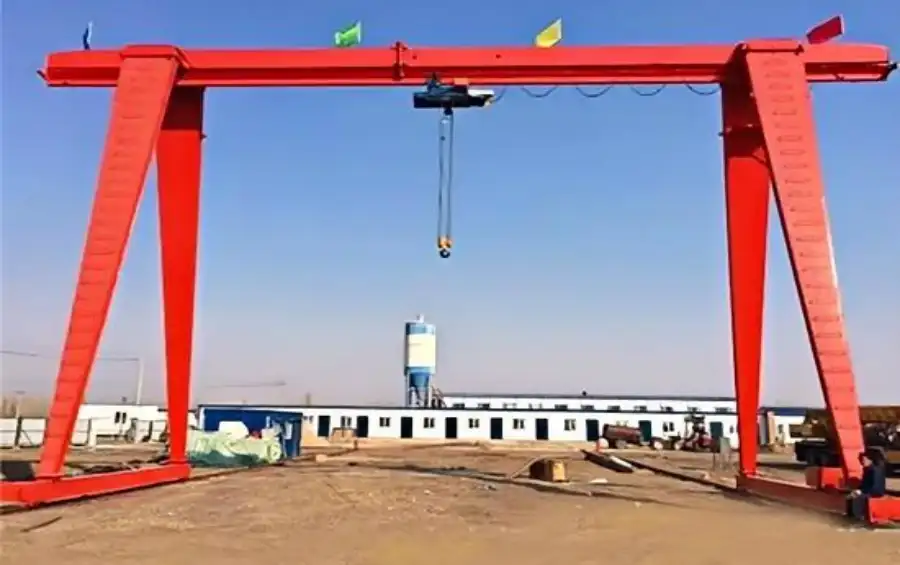
A single girder gantry crane is a floor-supported lifting system built around one horizontal beam carried by two vertical legs that travel on ground-level rails. Unlike overhead bridge cranes that depend on building columns and runway beams, this crane is structurally independent of the facility. That independence makes it the default choice for rented warehouses, outdoor storage yards, precast concrete plants, and workshops where roof-supported infrastructure is either unavailable or too costly to install.
The product sits in a specific performance window: it handles light to moderate loads with high cycle efficiency at a fraction of the cost of double girder systems. Understanding where that window ends — and when to step up to a double girder or semi-gantry configuration — is the core of a sound procurement decision.
Girder Architecture: Box Section vs. Truss Frame
The main beam of a single girder gantry crane comes in two structural forms, and the choice between them is driven by environment rather than preference.
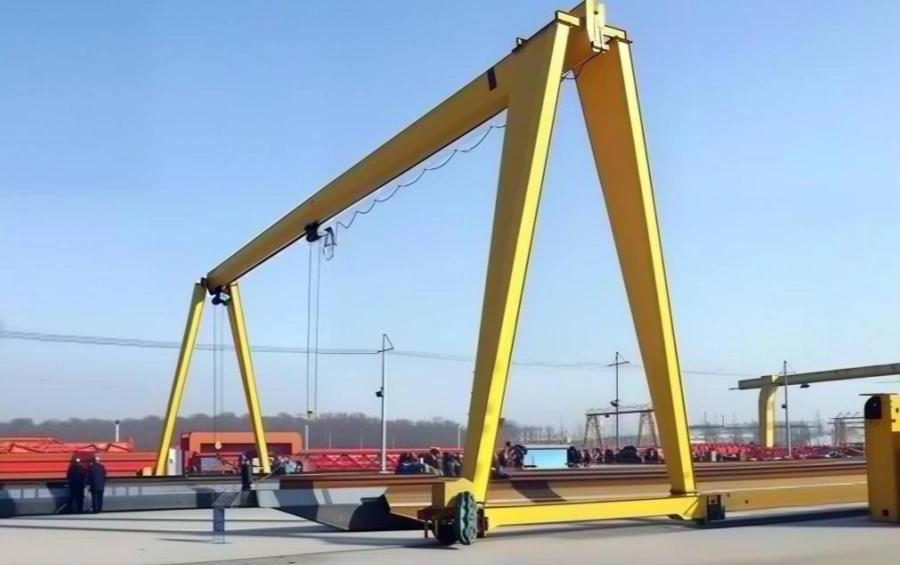
Box girder cranes use a welded, closed-section steel beam. The box profile provides high torsional rigidity and a smooth, accessible surface for trolley travel and maintenance. It is the standard for indoor workshops and facilities where the crane operates in a controlled environment. The solid web also simplifies the mounting of festoon cable tracks, walkways, and service platforms.
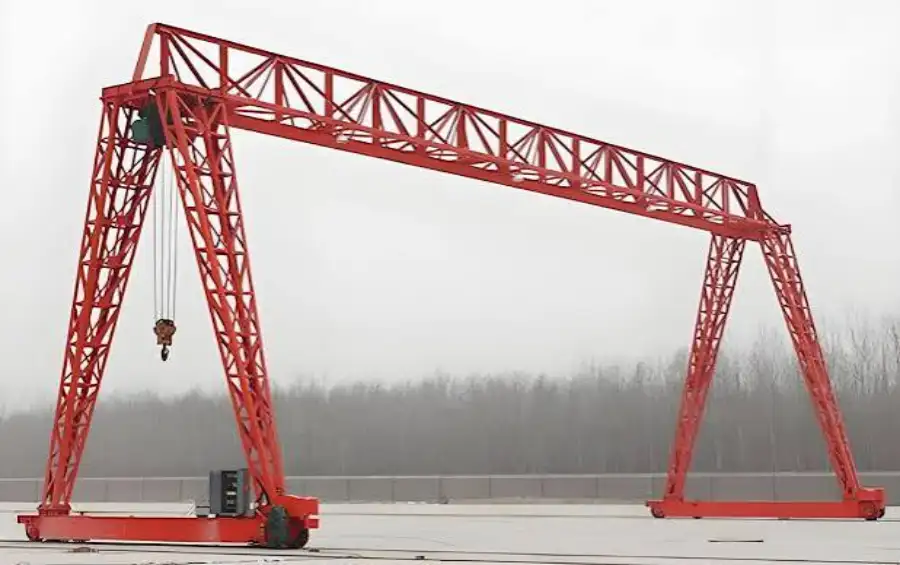
Truss (lattice) girder cranes are built from angle steel, I-beam, or tubular members welded into an open triangular framework. The truss design reduces self-weight by approximately 30% compared to an equivalent box girder and, more critically, slashes the windward area. For outdoor installations in exposed yards or coastal regions, the truss girder lowers wind load on the rail anchors and reduces the overturning moment on the foundation. The trade-off is that the open structure requires more frequent inspection of individual members and weld joints.
A third variant worth noting is the L-type single girder gantry crane, where one leg is vertical and the other is angled or offset. This configuration lowers the overall crane height for a given hook lift, making it suitable for sites with restricted headroom. However, the asymmetric leg design reduces lateral stiffness, so L-type cranes are best reserved for applications where the load is centered and side-pulling is minimal.
Capacity and Span: Practical Operating Limits
Single girder gantry cranes are engineered for a defined load envelope. Pushing beyond that envelope does not just risk structural failure — it triggers disproportionate cost increases as the girder must be overbuilt to control deflection.
| Parameter | Typical Range | Practical Note |
| Lifting Capacity | 1t – 20t (up to 32t in some truss designs) | Above 20t, double girder becomes more economical due to deflection control |
| Span (Rail to Rail) | 7.5m – 35m | Standard increments of 3m; spans beyond 30m require careful deflection analysis |
| Lifting Height | 6m – 18m | Determined by leg height; low-headroom hoists can add 0.5–1m of usable lift |
| Duty Class | A3 – A5 | A3/A4 for intermittent yard work; A5 for daily production shifts |
| Cantilever | Up to 1/3 of span | Common cantilevers: 2m, 2.5m, 3m; overhang capacity decreases with length |
A critical point buyers often miss: cantilever capacity is not equal to main span capacity. A 10-ton crane rated for 10 tons on the main span may only handle 6–7 tons at the end of a 3-meter cantilever. Suppliers should provide a capacity-overhang chart, and procurement teams must verify the cantilever rating against their heaviest outboard load.
Hoist Integration and Headroom Optimization
The hoist on a single girder gantry crane runs on the bottom flange of the main beam, which inherently limits hook height compared to a double girder system where the hoist sits between the beams. This makes low-headroom hoist selection one of the most impactful design decisions.
CD1/MD1 wire rope hoists are the conventional choice. CD1 offers single-speed lifting; MD1 adds a slow-speed gear for precision spotting. These hoists are robust, widely serviced, and compatible with 380V/50Hz or customized voltage standards.
European-style low-headroom hoists use a compact drum-and-trolley design that minimizes the distance between the hook and the girder bottom. In facilities with tight vertical clearance, switching from a standard hoist to a low-headroom European model can recover 0.8–1.2 meters of usable lift without raising the legs or modifying the foundation.
Variable frequency drive (VFD) control on both hoisting and travel axes is strongly recommended for spans over 15 meters or loads over 5 tons. VFDs eliminate the jerky start-stop motion that causes load swing, which is particularly important when handling long steel sections, precast panels, or fragile assemblies.
Foundation and Rail Installation
Because the crane's weight is transferred directly to the ground, foundation quality determines both safety and service life. There are three common installation approaches:
1.Direct rail on compacted ground — Suitable for temporary or semi-permanent outdoor yards. Rails are laid on leveled, compacted soil or gravel with drainage channels. This is the lowest-cost option but requires regular re-leveling and is not suitable for high-duty applications.
2.Concrete beam foundation — Reinforced concrete beams cast along the runway path, with embedded anchor plates for rail fixation. This is the standard for permanent installations. Rail gauge tolerance should be held within ±5mm, and the two rails must be level within 10mm across any cross-section to prevent crabbing and uneven wheel wear.
3.Steel base plate on existing slab — For indoor workshops with a sound concrete floor, base plates can be anchored directly to the slab using chemical or mechanical anchors. A structural engineer must verify the slab's load-bearing capacity against the crane's maximum wheel pressure, which can range from 37kN to over 180kN depending on capacity and span.
Rail type matters as well. QU-series crane rails (e.g., QU70, QU80) are preferred for capacities above 10 tons or high-cycle operations. Lighter applications can use P-series railway rails or square steel rails, but these wear faster and require more frequent adjustment.
When a Single Girder Gantry Crane Is the Wrong Choice?
Honest procurement requires knowing when not to buy this product. A single girder gantry crane should be reconsidered if:
Capacity exceeds 20 tons regularly. Deflection becomes difficult to control, and the cost advantage over a double girder system disappears.
Spans exceed 35 meters. Torsional stiffness drops sharply, and load swing becomes harder to manage without active anti-sway systems.
The application involves frequent side-pulling or eccentric loads. The single-beam design has limited resistance to torsional stress from off-
center lifting.
Duty class requirements exceed A5. For 24-hour continuous operation or severe service conditions (e.g., steel mill charging, foundry work), a double girder gantry crane with higher-specification motors, brakes, and reducers is the appropriate choice.
Headroom is extremely limited and hook height is critical. A double girder system places the hoist between the beams, recovering significant vertical space.
Procurement Specification Checklist
When requesting a quotation, buyers should provide the following data to avoid costly redesign cycles:
-Rated lifting capacity (including rigging weight; add 10–20% safety margin for future load growth)
-Span (rail-to-rail center distance, in meters)
-Cantilever length at each end and the required cantilever capacity
-Maximum lifting height (ground to hook center, in meters)
-Duty class (A3, A4, or A5, based on daily operating hours and lift frequency)
-Girder type preference (box for indoor, truss for outdoor/windy sites)
-Power supply standard (voltage, frequency, phase — e.g., 380V/50Hz/3-phase or 440V/60Hz)
-Control method (pendant pushbutton, cabin, or wireless remote)
-Operating environment (indoor/outdoor, temperature range, corrosive or explosive conditions)
-Special requirements (VFD control, anti-sway system, IP65 electrical enclosures, galvanized or fluorocarbon coating for coastal sites)
For outdoor installations, specify rain covers for the hoist and electrical cubicle, wind-resistant rail clamps or anchors, and a wind speed alarm if the site is prone to gusts above 20 m/s.
Frequently Asked Questions
Q: What is the maximum lifting capacity for a single girder gantry crane?
A: Single girder gantry cranes typically handle 1 to 20 tons, with some truss-frame designs extending to 32 tons. For loads above 20 tons or spans beyond 35 meters, a double girder gantry crane offers better structural stability and more economical deflection control.
Q: Can a single girder gantry crane be used outdoors?
A: Yes. For outdoor applications, a truss girder design is recommended due to its lower wind resistance. Specify rain covers for the hoist and electrical components, IP65-rated enclosures, and rail clamps or wind anchors to secure the crane during high-wind events.
Q: What is the difference between a single girder gantry crane and an overhead bridge crane?
A: A gantry crane is self-supporting with legs that travel on ground rails, requiring no building structure. An overhead bridge crane is suspended from runway beams attached to building columns. Gantry cranes are ideal for rented facilities, outdoor yards, or buildings with weak roof structures; overhead cranes save floor space but depend on existing building infrastructure.
Q: How long does installation take?
A: A standard 10-ton, 20-meter span single girder gantry crane typically requires 3–5 days for rail laying, assembly, and commissioning by a qualified team. Larger spans, custom cantilevers, or complex foundation work can extend this to 7–10 days.